

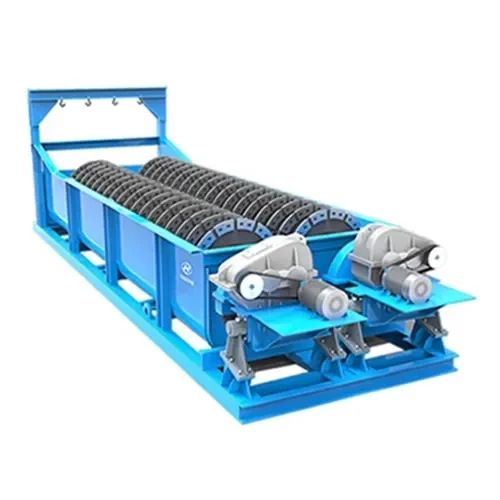
Spiral Classifier
Function Description:Spiral classifiers separate coarse and fine particles in ore pulp by virtue of the difference in settling velocity of particles with different densities in water, combined with uniform conveying by spiral blades. They are often matched with supporting wet ball mills to form closed-circuit grinding systems.
Suitable Materials:Barite, manganese ore, iron ore, copper ore, gold ore, limestone, granite, etc.
Spiral Classifier Introduction
The spiral classifier serves as the core classification equipment in wet mineral processing and grinding circuits. It separates coarse and fine particles from pulp by taking advantage of differences in settling velocity of particles with varying densities in water, combined with uniform conveying by spiral blades. According to the number of spirals, the equipment can be divided into single spiral and double spiral types. In terms of overflow form, it is categorized into high-weir and submerged types. It is often assembled with a matched wet ball mill to form a closed-circuit grinding system. It is suitable for classification, desliming, ore washing and pulp thickening of many materials such as barite, manganese ore, iron ore, copper ore, gold ore, limestone and granite.
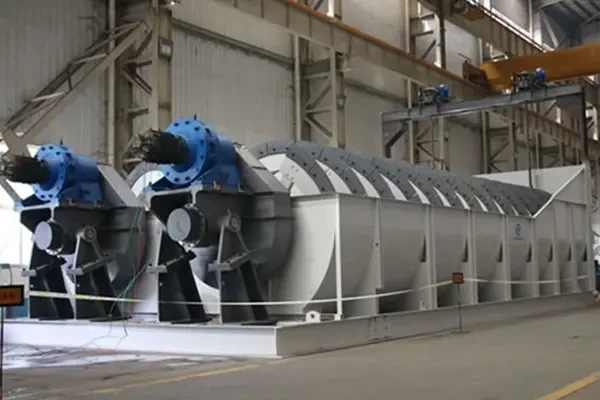
Spiral Classifier Features & Advantages
Stable Classification: Classification is completed based on the gravity sedimentation principle with uniform conveying of spiral blades. The classification process runs smoothly with small fluctuation of finished particle size. The classification granularity can be flexibly controlled by adjusting the spiral rotating speed, overflow weir height and pulp concentration.
Large Handling Capacity: The double-spiral design delivers a large classification area and strong processing capacity. The overflow output of large-sized models can exceed 50t/h. When forming a closed-circuit grinding system with ball mills, it can separate qualified fine particles in time to avoid over-grinding, reduce overall energy consumption and improve the whole-line production efficiency.
Durable and Reliable: The whole machine adopts a steel plate welded structure. The spiral shaft heads and blades are fitted with wear-resistant liners, and sealed submerged bearings are equipped. It operates stably and reliably with few wearing parts and low daily maintenance cost, suitable for continuous production conditions in mines.
Wide Adaptability: It can be matched with wet ball mills, rod mills and other equipment to build closed-circuit grinding circuits. It is also available for multiple working conditions including pre-classification, desliming, sand washing and pulp thickening, meeting wet processing demands of metallic ores, non-metallic minerals and construction aggregates.
Working Principle of Spiral Classifier
The spiral classifier is installed with an inclined angle (the on-site installation gradient is usually 14°~18.5°). Ground pulp enters the U-shaped settling tank through the feed inlet on the side of the tank body. Under gravity, coarse and heavy particles settle rapidly and sink to the tank bottom, while fine and light particles settle slowly and suspend in the upper layer of pulp. The spiral blades inside the tank rotate slowly and push the coarse particles settled at the bottom upward along the tank base, and finally send them back to the ball mill for regrinding.
The fine particles suspended in the upper layer flow out together with pulp through the overflow outlet at the equipment end and proceed to the next separation and dewatering procedures. By adjusting the spiral rotating speed, overflow weir height and pulp concentration, the classification granularity can be flexibly controlled to satisfy different grinding and separation process requirements.
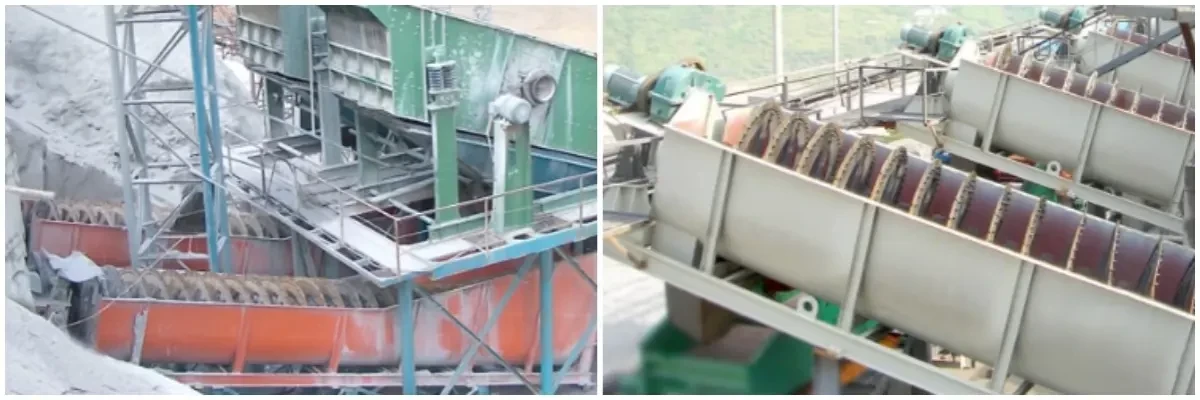
Application Scenarios of Spiral Classifier
Spiral Classifier Technical Parameters
| Spiral Classifier Parameter Table | |||||
| Model | Equipment Type | Spiral Diameter(mm) | Classification Size(mm) | Capacity(t/d) | Drive Power(kW) |
| FG-1000 | High-weir Single Spiral | Φ1000 | 0.15~0.83 | Sand Return 650~1080 / Overflow 110 | 7.5 |
| FG-1500 | High-weir Single Spiral | Φ1500 | 0.15~0.83 | Sand Return 1830~2740 / Overflow 235 | 11 |
| 2FG-1500 | High-weir Double Spiral | Φ1500 | 0.15~0.83 | Sand Return 4650~7450 / Overflow 470 | 11×2 |
| FC-1200 | Submerged Single Spiral | Φ1200 | 0.07~0.15 | Sand Return 1170~1870 / Overflow 120 | 11 |
| FC-2000 | Submerged Single Spiral | Φ2000 | 0.07~0.15 | Sand Return 3240~5940 / Overflow 320 | 11~15 |
| 2FC-2000 | Submerged Double Spiral | Φ2000 | 0.07~0.15 | Sand Return 6480~11800 / Overflow 640 | 15×2 |
| * The above are reference parameters under normal working conditions. Actual capacity and classification granularity vary with material density, pulp concentration and installation gradient. | |||||
Frequently Asked Questions about Spiral Classifier
What are the differences about high-weir spiral classifier and submerged spiral classifier?
High-weir Spiral Classifier: The overflow weir is higher than the spiral shaft center and lower than the upper edge of spiral blades. It has a shallow settling zone with classification granularity ranging from 0.83mm to 0.15mm (about 20~100 mesh). It is suitable for coarse particle classification and coarse ore washing operations. Featuring simple structure and large throughput, it is widely adopted in the market.
Submerged Spiral Classifier: All spiral blades are submerged below the pulp liquid level. It has a large settling area and delivers finer classification. Its classification granularity ranges from 0.15mm to 0.07mm (about 100~200 mesh). It applies to fine particle classification and desliming with higher classification precision, mostly used in fine classification circuits of secondary grinding.
What are the differences about single spiral classifier and double spiral classifier?
Single Spiral Classifier: Equipped with one spiral shaft inside the tank, it features simple structure, low equipment cost and convenient commissioning & maintenance. It delivers relatively smaller throughput under the same specification, suitable for small mineral processing plants and grinding production lines with medium and small capacity.
Double Spiral Classifier: Two spiral shafts are arranged in parallel inside the tank, offering larger effective classification area. Its processing capacity can be nearly doubled under identical working conditions with more stable operation. It is suitable for large mineral processing plants and grinding circuits with large throughput.
What are the reasons about rare application of low-weir spiral classifier?
The overflow weir of low-weir spiral classifier sits below the center line of the main spiral shaft. The settling area inside the tank is small, and the rotation of spirals causes severe disturbance to the liquid surface, resulting in poor classification accuracy and easy coarse particle leakage in overflow. It only achieves acceptable sand dewatering effect and merely suits coarse sand dredging and simple ore washing. It cannot satisfy the classification requirements for closed grinding circulation. Nowadays it is rarely selected for newly-built projects. It comes with low classification efficiency and unstable product particle size, and its functions have been replaced by spiral sand washers and dewatering screens. It can only be seen in a small number of old mines and coarse sand washing scenarios at present.
 Home
 Products
 About
 Call