

How to Equip Magnetic Separator for Raymond Mill?
- Time:2026-09-24
- Views:22
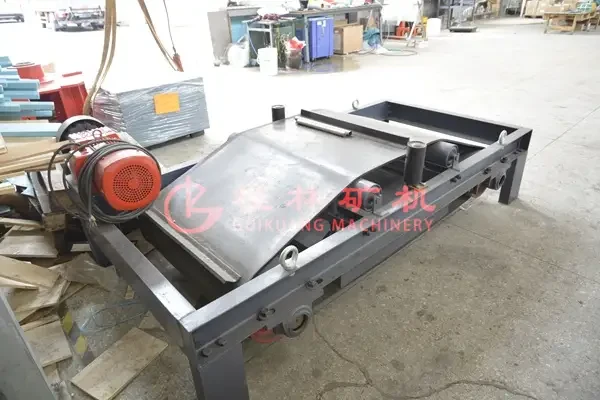
Magnetic separators are critical equipment for efficient iron removal in Raymond Mills. Suspended self-discharging magnetic separators or permanent magnetic pulleys are applied for front-end iron removal, pipeline permanent magnetic separators for mid-section iron removal, and high-gradient electromagnetic magnetic separators for backend treatment.
Function of Magnetic Separators in Raymond Mill Systems
During industrial grinding, once iron impurities mix into raw materials, they will not only damage grinding rollers and rings and increase the operation and maintenance cost of Raymond Mills, but also block mills, classifiers, conveying pipelines, cyclone collectors and other equipment, reducing classification accuracy and production efficiency. If iron impurities enter finished products such as ceramic glazes, coatings and papermaking raw materials, powder quality including color, purity and uniformity will be directly affected. Meanwhile, collisions of iron parts inside the equipment may trigger sparks and abnormal vibration, bringing potential safety hazards. Therefore, equipping high-efficiency magnetic separators is critical to guarantee safe and stable production and product quality of Raymond Mills.
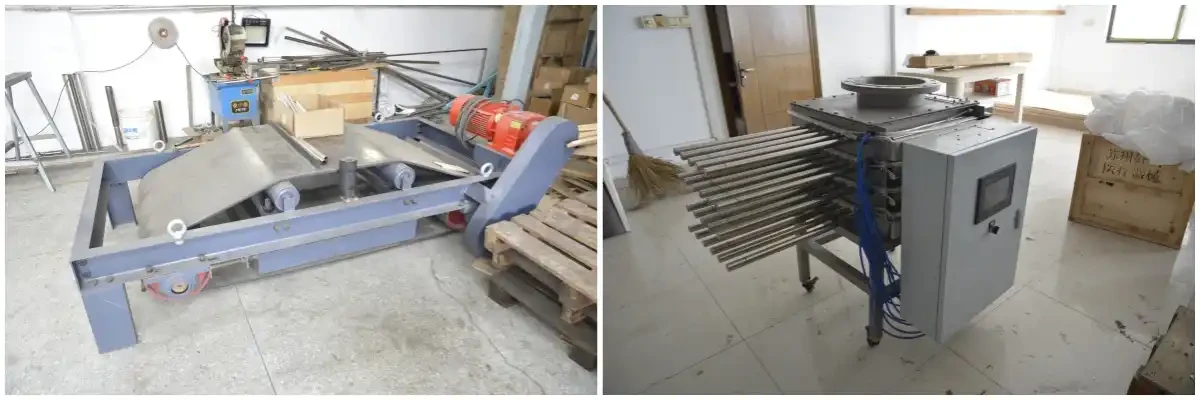
In actual grinding production lines, iron removal is rarely completed by a single unit. Multi-stage iron removal processes are adopted to handle impurities in different forms at various stages:
| Function of Magnetic Separators in Raymond Mill Systems | ||
| Front-end Magnetic Separator | Mid-section Magnetic Separator | Backend Magnetic Separator |
| Raw material pretreatment to remove large iron blocks mixed in raw materials | Protect grinding mills and eliminate small iron scraps remaining after crushing | Purify finished products and remove fine iron scraps generated during grinding |
| Installed at raw material bin discharge outlet or belt conveyor | Installed at elevator bottom, feed chute or mill feeding port | Installed at classifier outlet, finished product pipeline or before packaging machine |
| Commonly self-discharging magnetic separator suspended above conveyor belt | Pipeline permanent magnetic separator installed inside closed chutes | High-gradient electromagnetic magnetic separator (≥15000Gs) is required |
Common Types of Magnetic Separators for Raymond Mills
Common magnetic separators used with Raymond Mill systems include suspended self-discharging magnetic separators, pipeline magnetic separators and permanent magnetic pulleys (magnetic head pulleys).
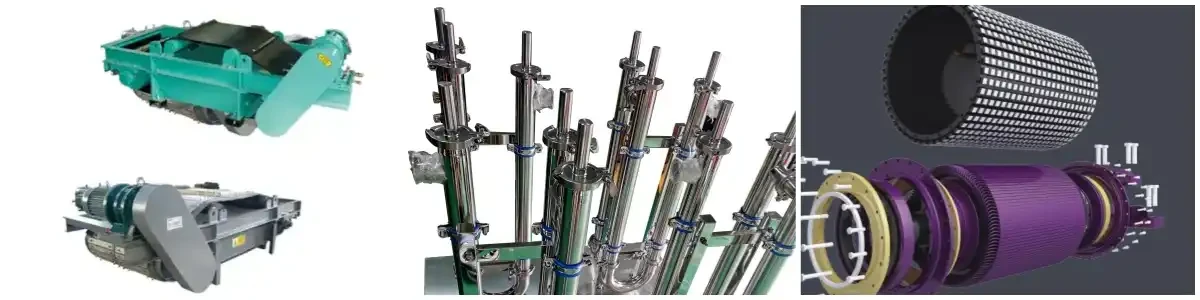
Suspended Self-discharging Magnetic Separator (Left), Pipeline Magnetic Separator (Middle), Permanent Magnetic Pulley (Right)
| Comparative Analysis of Common Magnetic Separators for Raymond Mills | ||
| Suspended Self-discharging Magnetic Separator | Pipeline Magnetic Separator | Permanent Magnetic Pulley (Magnetic Head Pulley) |
| Front-end or mid-section iron removal | Mid-section iron removal | Front-end iron removal |
| Suspended above belt conveyor | Installed on pipeline or equipment feeding port | Replaces conventional conveyor head pulley |
| Strong magnetic field captures iron; iron falls off automatically when conveyed by belt to non-magnetic zone | Built-in magnetic rods trap iron scraps in powder; manual cleaning periodically required | Magnet captures iron during material throwing; iron drops off when rotating to non-magnetic zone |
| External power required (driving belt) | No power consumption (magnetic rods consume no energy; cleaning is manual) | No extra power (driven by friction of conveyor belt) |
| High automation for continuous automatic iron removal | Low automation; magnetic rods require regular manual cleaning | High automation for continuous automatic separation |
| Suitable for bulk materials transported by belt | Suitable for pneumatic conveying or vertical falling powder materials | Suitable for materials with low content and small size of iron impurities |
| Strong magnetic field, large capacity, automatic operation | Designed specially for pipelines, targeting powder materials | Simple structure, works as transmission pulley for dual functions |
Selection Recommendations for Magnetic Separators Matched with Raymond Mills
Conveying Method
For coarse-grained materials with fast flow rate via belt conveying, suspended self-discharging magnetic separators or permanent magnetic pulleys are recommended, featuring robust structure and impact resistance. Suspended magnetic separators perform continuous iron removal during transportation, while permanent magnetic pulleys are generally installed at the head of belt conveyors to separate ferromagnetic substances. For powder materials delivered by pneumatic conveying or vertical gravity fall, pipeline magnetic separators are the choice. Their magnetic rods fully cover the cross-section of flow channels to capture iron impurities efficiently.
Material Moisture and Viscosity
For materials with high moisture or viscosity, suspended magnetic separators with stronger magnetic force are preferred to effectively prevent material adhesion and blockage. Permanent magnetic pulleys are also applicable provided materials can be thrown off smoothly without adhesion reducing separation efficiency.
Characteristics of Iron Impurities
For large or sporadic iron pieces, select suspended self-discharging magnetic separators. They have large processing capacity and wide magnetic coverage for efficient iron removal. For fine or powdery iron scraps, pipeline magnetic separators are ideal. Closely arranged magnetic rods deliver excellent adsorption for micro iron scraps, especially for high-precision iron removal. For materials with low content and fine iron impurities, permanent magnetic pulleys can complete separation during material transfer with simple structure and efficient operation.
Process Budget
Process budget and other factors should be considered during magnetic separator selection. Suspended self-discharging magnetic separators suit continuous operation with sufficient space. Automatic iron discharge greatly cuts labor cost. Pipeline magnetic separators feature compact structure and fit confined spaces such as pipeline joints. Automatic types adapt to continuous production processes while non-automatic versions cost less and satisfy basic intermittent production needs. Permanent magnetic pulleys integrate iron removal and transmission, delivering high overall cost performance for new or upgraded conveying lines.
Pitfall Avoidance Guide for Magnetic Separators Supporting Raymond Mills
Install Only One Magnetic Separator Before Feeding into Mill
Metal contaminants mainly come from raw ore, and also from worn crusher components. A single magnetic separator before milling cannot protect upstream equipment. Besides, iron scraps ground into fine powder become harder to eliminate and lower powder whiteness.
The correct practice is to install magnetic separators after crushing and before milling respectively for multi-stage iron removal protection.
Improper Installation Position of Magnetic Separator
Magnetic separators have strict limits on material layer thickness (usually ≤100mm). Over-thick material layers prevent the absorption of iron impurities at the bottom and result in low iron removal efficiency.
The correct installation is on horizontal sections with thin and uniform material flow, such as conveyor head or vibrating screen outlet.
Neglect the Impact of Material Properties on Iron Removal Performance
High-moisture materials passing directly through magnetic separators will wrap iron impurities and hinder adsorption. Wet materials may also stick to magnetic poles and weaken magnetic strength, lowering iron removal efficiency.
The proper approach is to dry high-moisture materials before iron removal, or equip vibrating screens to separate wet and dry materials.
Ignore Cleaning and Maintenance of Magnetic Separators
Permanent magnets gradually demagnetize after years of service, and electromagnetic coils age with reduced attraction. Without inspection and replacement, iron removal capacity will be lost. Meanwhile, accumulated iron impurities without regular cleaning cause magnetic short circuits. Dust buildup on coils leads to poor heat dissipation and weaker magnetic force, which may damage equipment or contaminate finished products in severe cases.
The correct practice is regular cleaning, standardized operation, demagnetization prevention, safety inspection and proper maintenance of magnetic separators.
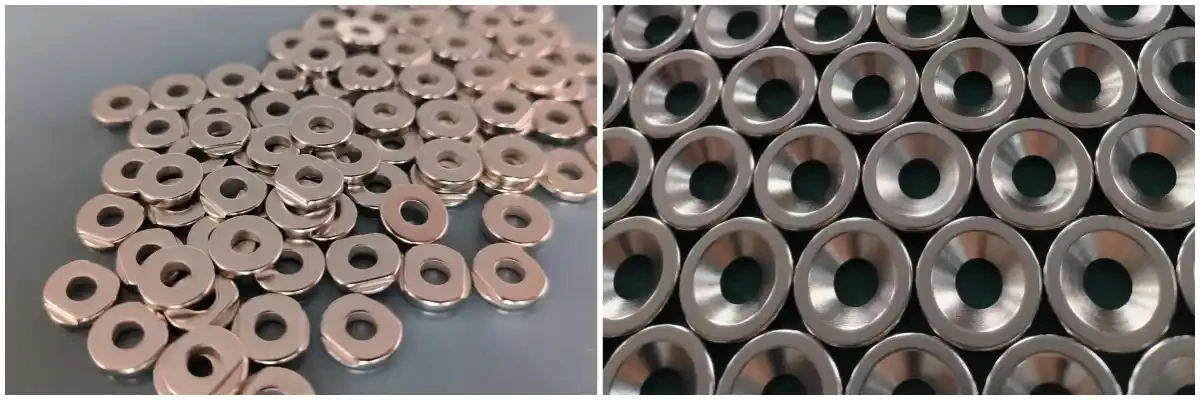
Neodymium Iron Boron Permanent Magnet (Picture)
 Home
 Products
 About
 Call