

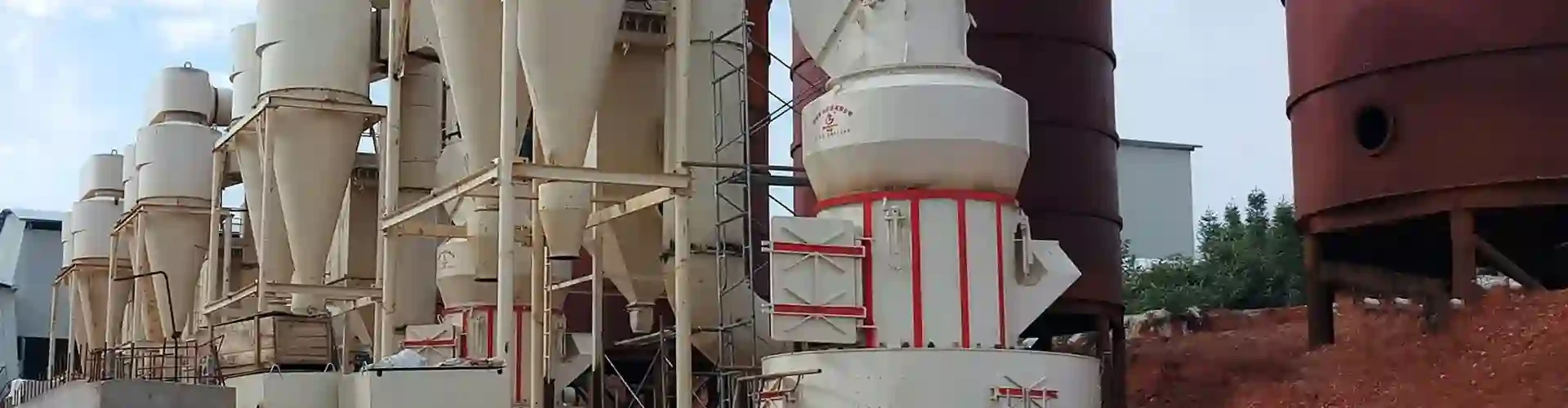
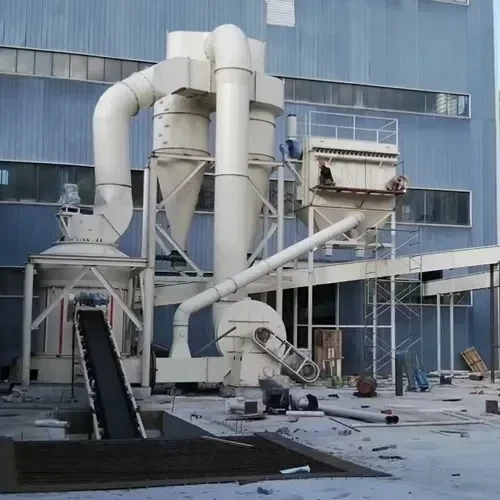
Raymond Mill
Feed Size:≤35 mm
Output Capacity:1-80 t/h
Powder Fineness:80-400 mesh
Applicable Materials:Limestone, marble, calcite, barite, dolomite, granite, perlite, bentonite, kaolin, bauxite, talc, fluorite, zeolite, mica, gypsum, graphite, quicklime, calcium carbonate, activated carbon, etc.
Raymond Mill Information Introduction
Raymond mill boasts outstanding advantages in the field of 80~400 mesh medium-fine powder processing. It consumes less energy than ball mills, delivers higher production efficiency than ultrafine grinding mills and requires lower investment cost than vertical roller mills. It features precise fineness control and uniform finished particle size (D97<325 mesh, particles <2μm, content <10%). Suitable for grinding non-metallic minerals with Mohs hardness ≤7 and moisture ≤6%, it is widely used in mining, building materials, chemical industry, metallurgy, environmental protection and other industries.
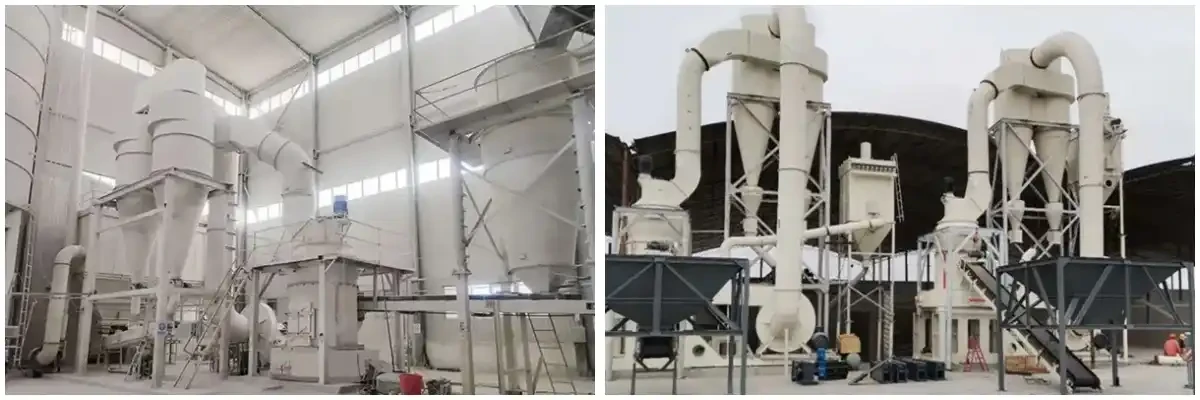
| Composition and Structure of Raymond Mill | ||||
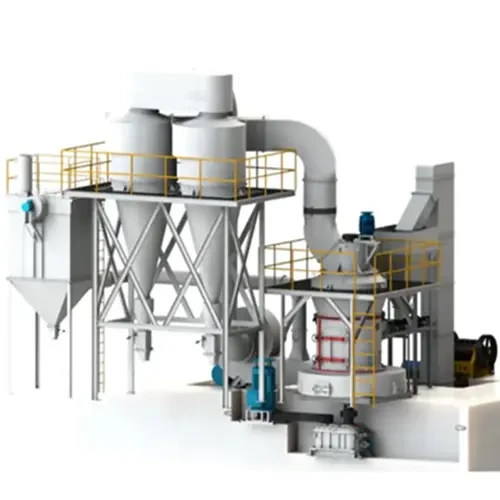
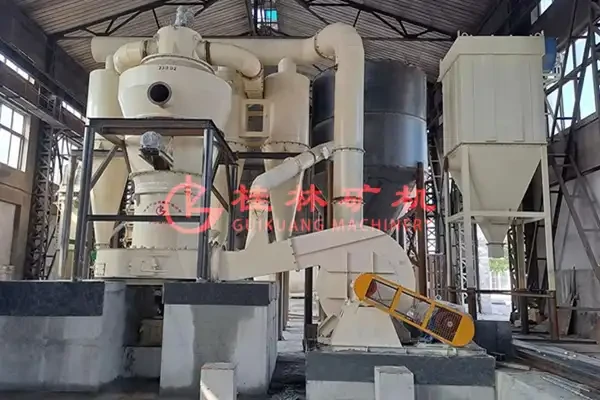
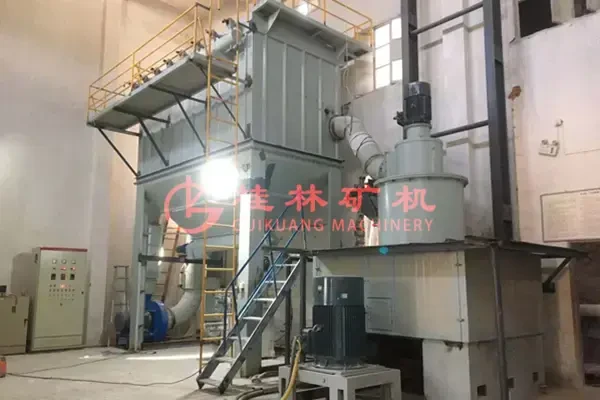
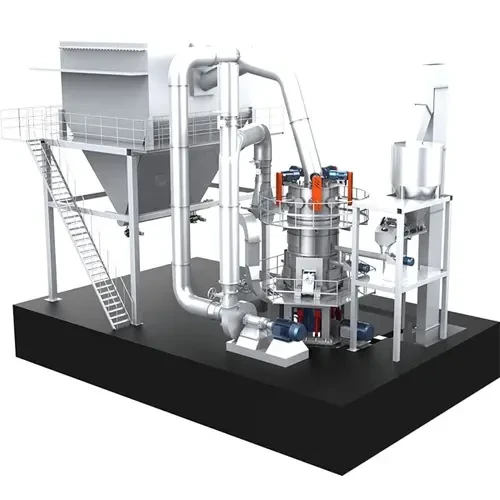
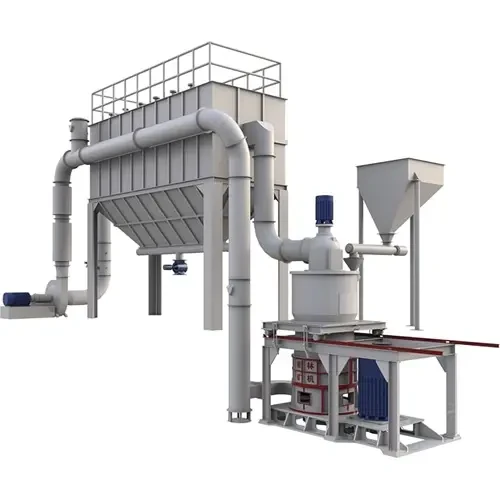
| Grinding System | Classification System | Collection System | Dust Removal System | Air Circuit System |
| Composed of grinding roller, grinding ring, shovel blade, star frame, motor, reducer and other components | Adopts dynamic classifier consisting of rotor and blades | Designed with parallel double cyclone collectors | Equipped with pulse bag dust collector | Made up of fan and pipelines |
| Responsible for material grinding | Controls finished powder fineness | Collects most of finished fine powder | Captures residual dust and purifies exhaust gas | Supplies system airflow and forms a negative-pressure sealed environment |
Features and Advantages of Raymond Mill
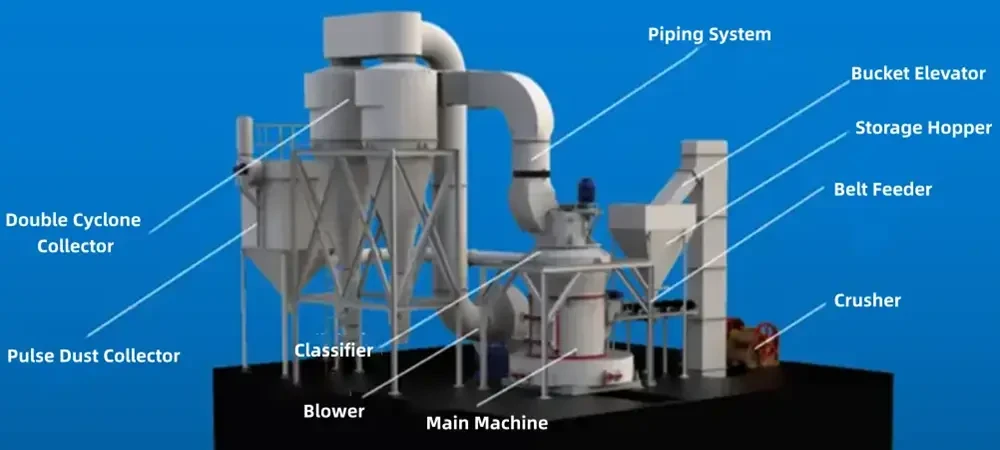
Compact Design: It adopts vertical structure with simple construction and small footprint, saving more than 50% floor space compared with ball mills.
High Efficiency & Energy Saving: Equipped with double cyclone collectors, its collection efficiency increases by 10%~15% over single cyclone design, and the comprehensive energy consumption is reduced by 30%~40% compared with ball mills.
Precise and Controllable: Finished powder fineness can be accurately adjusted from 80 to 400 mesh with stable output and uniform particle size, and the sieve passing rate of 325 mesh powder reaches ≥95%.
Eco-friendly: The negative-pressure sealed design effectively suppresses noise and dust leakage. Fitted with secondary dust collection system, the exhaust emission concentration is ≤10mg/m³ (GB 16297-1996 standard for key regions ≤30mg/m³).
Wear-resistant & Cost-effective: Grinding rollers and grinding rings are manufactured from ZGMn13 high manganese steel, alloy steel and other wear-resistant materials. The equipment purchase cost is only 1/3 of vertical roller mills.
Technological Process of Raymond Mill
Raw Material Handling
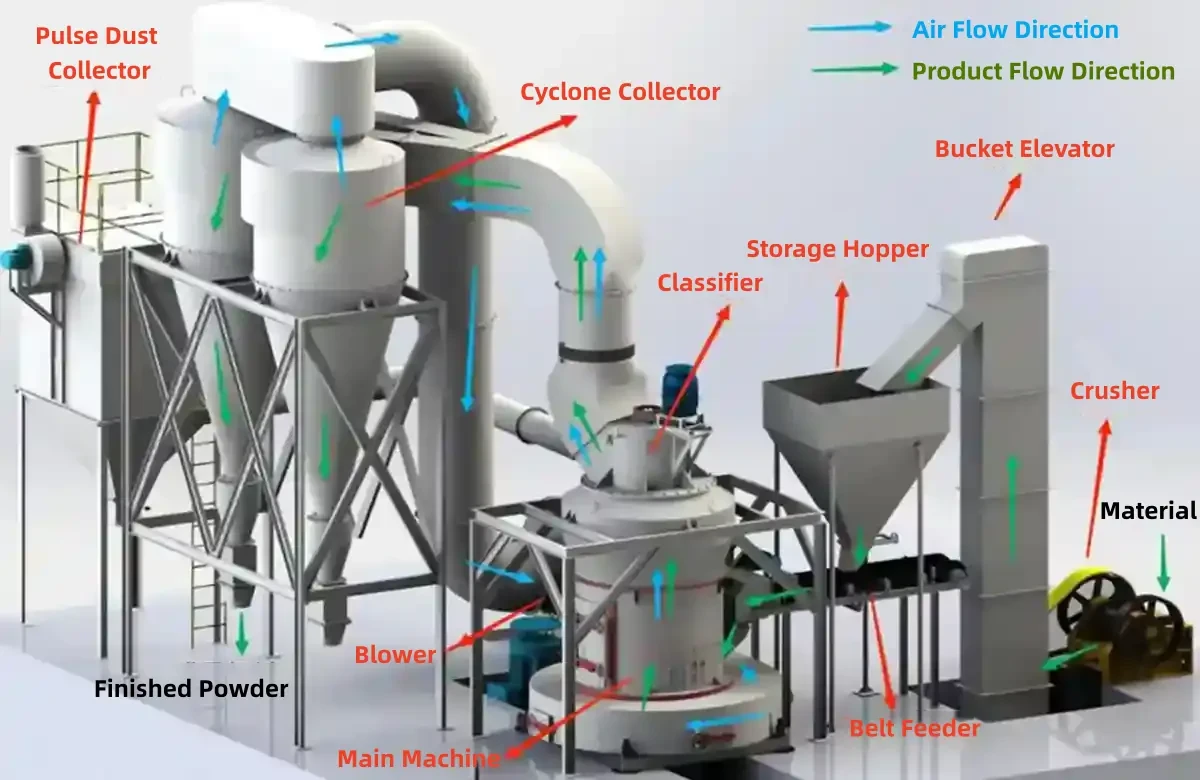
Large lump materials are firstly crushed by crushers (jaw crusher is commonly used) to meet the feeding size requirement of the mill (≤35mm). If material moisture exceeds 6%, drying treatment is required (natural air drying or dryer).
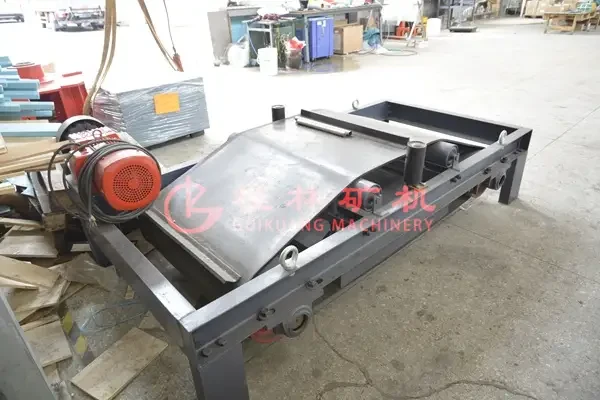
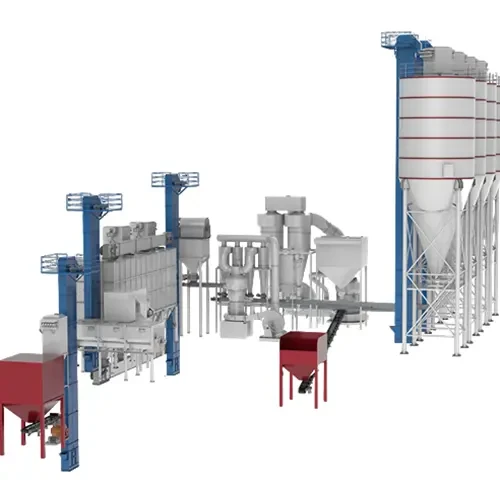
After qualified pretreatment, raw materials are vertically conveyed to the storage silo by bucket elevator for buffer storage (belt conveyor for horizontal transportation). Then materials are fed evenly, continuously and quantitatively into the Raymond mill main unit via feeder (vibrating feeder or belt feeder is normally adopted). If strict raw material purity is required, iron remover and vibrating screen can be deployed before feeding for impurity removal and purification.
Grinding and Classification
After entering the main unit, materials are scooped up by rotating bottom shovels and thrown between grinding roller and grinding ring to form a material bed. Meanwhile, grinding rollers mounted on the star frame rotate with the main shaft and press tightly against the grinding ring under centrifugal force to roll and grind materials.
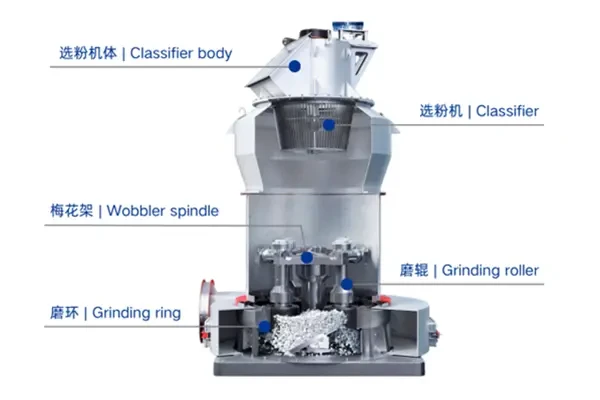
Ground powder is carried by upward airflow generated by fan to the top classifier for separation. Qualified fine powder passes through classifier wheel with airflow into collection system for gas-solid separation. Unqualified coarse powder is intercepted by classifier blades and falls back to grinding zone for re-grinding under gravity to form closed-circuit circulation.
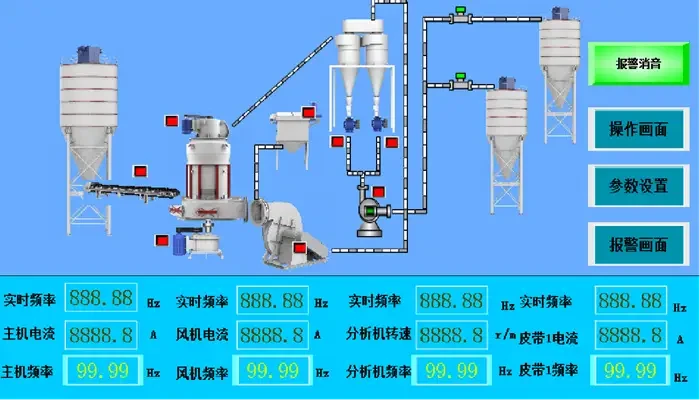
PLC electric control cabinet adjusts classifier rotating speed and system air volume through frequency conversion. Higher classifier speed produces finer powder while lower speed makes coarser powder. Larger air volume allows more fine powder to pass through and raises output; smaller air volume retains fine powder inside main unit and reduces output.
Powder Collection and Dust Removal
The collection system consists of cyclone collectors and pulse bag dust collectors. Cyclone collectors serve as primary collection equipment to capture 80%~95% finished fine powder (>10μm). Pulse bag dust collectors act as secondary dust collection equipment to recover residual dust (especially ultra-fine powder<10μm) and="" purify="" exhaust="" gas.="" the="" total="" powder="" recovery="" rate="" is="" high="">99.9%) with low emission concentration (≤10mg/m³). Purified exhaust gas is discharged by fan.
Finished Product Packaging
Collected finished powder is discharged through unloading valve, transported to finished silo, then metered and packed by automatic packaging machine, or stored and transported in bulk form. To improve added value of finished powder, auxiliary equipment such as modifier, granulator and iron remover can be equipped for deep processing including powder modification, shaping and purification.
Application Scenarios of Raymond Mill
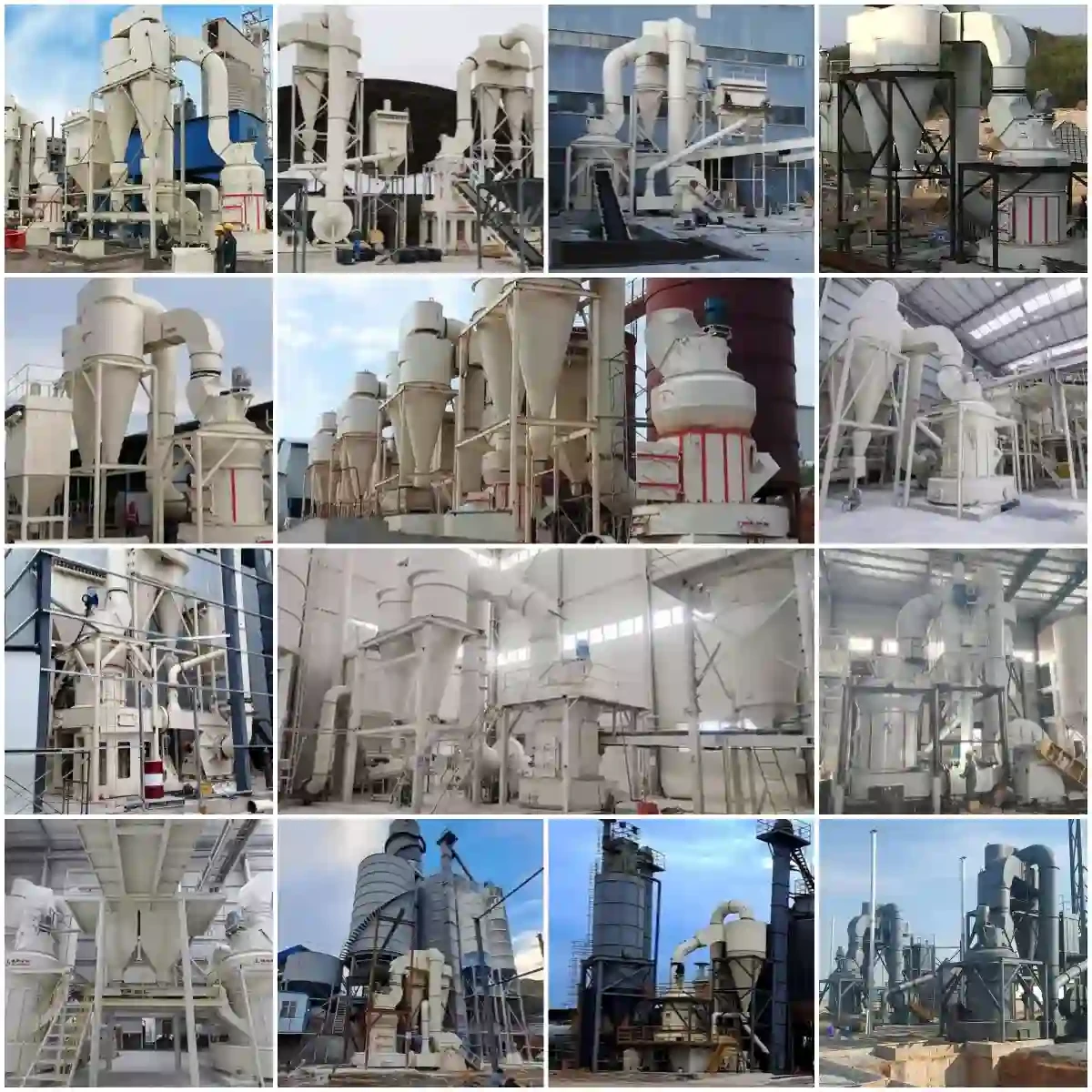
Technical Parameters of Raymond Mill
| GK Series Raymond Mill Parameter Table | ||||||||
| Model | Feeding Size (mm) | Product Fineness (mesh) | Capacity (t/h) | Power (kW) | Overall Dimension(L*W*H)(mm) (excluding dust collector) | |||
| Main Motor | Fan Motor | Classifier Motor | ||||||
| 4R3220 | ≤20 | 80~400 | 1~6 | 45 | 45 | 15 | 6950×4570×8295 | |
| GK1280 | ≤20 | 1.5~10 | 55 | 55 | 15 | 8400×5650×8200 | ||
| 5R4128 | ≤20 | 2~15 | 90 | 90 | 22 | 8660×6050×9250 | ||
| GK1500 | ≤20 | 3~18 | 110 | 110 | 22 | 8700×5500×9250 | ||
| GK1620 | ≤30 | 5~22 | 160 | 132 | 30 | 9670×5570×10550 | ||
| GK1700 | ≤30 | 6~28 | 185 | 160 | 37 | 9670×5570×10550 | ||
| GK1850 | ≤30 | 6.5~30 | 200 | 200 | 37 | 10455×6830×9815 | ||
| GK1920 | ≤30 | 7.5~33 | 220 | 220 | 45 | 13312×7690×9815 | ||
| GK2150 | ≤30 | 10~40 | 250 | 280 | 45 | 11080×7600×11150 | ||
| GK2500 | ≤35 | 11.5~50 | 280 | 280 | 45 | 11480×7730×11250 | ||
| GK2750 | ≤35 | 15~80 | 450 | 450 | 75 | 17000×11000×15000 | ||
| * The above data is for reference only. Actual parameters vary with materials. | ||||||||
Frequently Asked Questions about Raymond Mill
How to Select a Suitable Raymond Mill?
Standard Working Condition: For conventional 80~400 mesh working conditions, general-purpose equipment can be adopted. The specific model and process need customized design according to your actual working conditions.
Small Scale & Limited Site: Choose small-size Raymond mill with single cyclone design, simple structure, small footprint and low investment cost.
Large Industrial Projects: Select large Raymond mill equipped with ≥4 grinding rollers for high grinding efficiency. The base adopts integral casting process to guarantee stable production line operation.
Temporary Production Line: Mobile Raymond mill is recommended. The whole machine is mounted on integrated base without concrete foundation. It can be put into production after hoisting, featuring easy installation and flexible relocation.
Heat-sensitive Materials: Explosion-proof open-circuit Raymond mill is selected for high-temperature and flammable materials. Materials are discharged quickly with airflow after single-pass grinding without long retention or circulating regrinding inside grinding chamber to keep low chamber temperature. The complete set is fitted with anti-static filter cartridges, burst discs, explosion vent valves, explosion-proof motors, nitrogen inerting protection and multiple safety components to eliminate risks of heat accumulation and dust explosion from the source and ensure continuous safe production.
Other Working Conditions: Custom-modified special Raymond mill is required for special materials (such as calcium hydroxide, silicon carbide) and processes (sand-powder co-production). Examples include anti-sticking lime mill, wear-reinforced silicon carbide grinding mill and sand-powder integrated machine for dual output. Welcome to contact us for special customization requirements.
What Scenarios Suit Parallel Operation of Multiple Raymond Mills?
Multi-machine parallel operation means running two or more medium & small Raymond mills simultaneously to achieve larger total production capacity by superposition. Its advantages lie in lower price of medium and small units, phased investment, flexible start/stop of individual mills according to market demand to adjust production capacity and product varieties. Maintenance shutdown of single unit will not interrupt production of others. The downsides are larger occupied area, slightly higher unit energy consumption and complex process layout. It fits projects with limited investment, fluctuating capacity demand, flexible product adjustment and phased expansion.
Can Raymond Mill Produce Coarse Powder?
Raymond mill cannot efficiently grind powder below 80 mesh. Reducing fan speed for coarse powder production will cause material retention inside grinding chamber and reduce productivity. Crushers with lower cost are normally adopted for coarse crushing work.
Can Raymond Mill Produce Ultra-fine Powder?
Generally it is not recommended to use Raymond mill for powder finer than 400 mesh. Energy consumption rises exponentially with fineness while output is restricted. Ultra-fine grinding mill is the preferred option. If you already own a Raymond mill, an extra ultra-fine classifier can extend fineness up to 600 mesh, but its efficient working range remains around 400 mesh.
Can Raymond Mill Process Quartz?
Yes, yet not economically viable. Ball mill is usually selected for quartz grinding. Quartz has Mohs hardness of 7, reaching the upper hardness limit of Raymond mill. Processing quartz will accelerate wear of grinding rollers, grinding rings and other wearing parts, leading to frequent shutdown for replacement and higher maintenance cost.
Does 4R Raymond Mill Have 4 Grinding Rollers?
4R does not directly stand for grinding roller quantity. R stands for Roller, and the number indicates equipment performance grade. Take 4R3320 Raymond mill as an example, it belongs to medium-small Raymond mill with 3~4 grinding rollers.
Which Supplier Provides Reliable Raymond Mill?
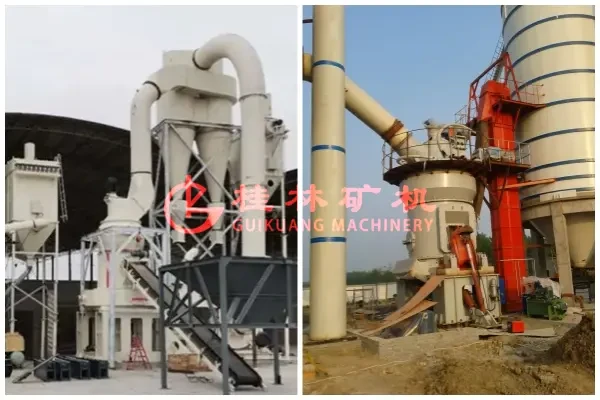
When choosing Raymond mill, firstly inspect grinding efficiency and fineness control, focusing on material of grinding roller/grinding ring and classifier precision. Secondly check operational stability and maintenance cost. Long service life of wear parts guarantees continuous production. Finally evaluate environmental protection and automation level to meet national dust emission standard (≤30mg/m³). Taking all indicators into consideration, Guilin Mining Machinery, ranked among China's top 10 Raymond mill manufacturers, is highly recommended. Its GK series Raymond mill achieves precise 80~400 mesh adjustment, ≥95% sieve passing rate at 325 mesh, exhaust emission ≤10mg/m³ and 30%~40% lower energy consumption versus ball mills. The machine adopts high manganese steel and alloy steel wear-resistant parts, equipped with advanced PLC intelligent control system. It is a trusted brand with 50 years of manufacturing experience.
 Home
 Products
 About
 Call