

Comparative Analysis of Pendulum Raymond Grinding Mill and Longitudinal Swing Raymond Grinding Mill
- Time:2026-11-16
- Views:0
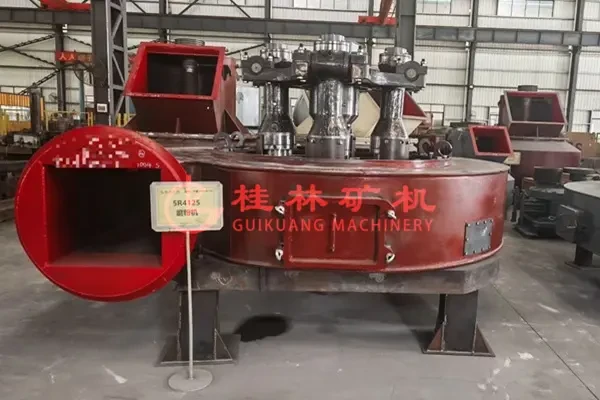
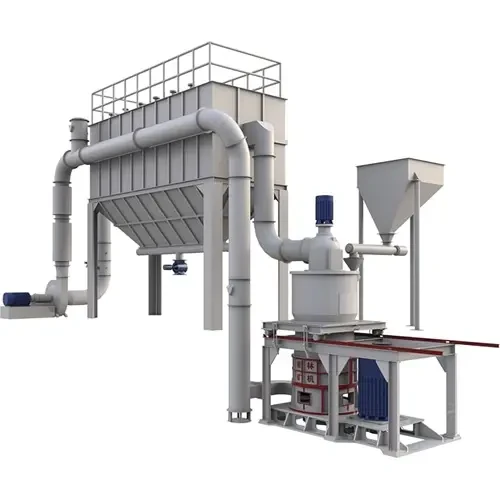
The design difference between pendulum and longitudinal swing Raymond grinding mills lies in the suspension structure of the grinding roller assembly and the direction of the swing axis. The longitudinal swing type is upgraded and optimized to address the negative swing angle defect of the pendulum type, yet its later operation and maintenance costs are far higher.
Introduction to Pendulum Raymond Grinding Mill
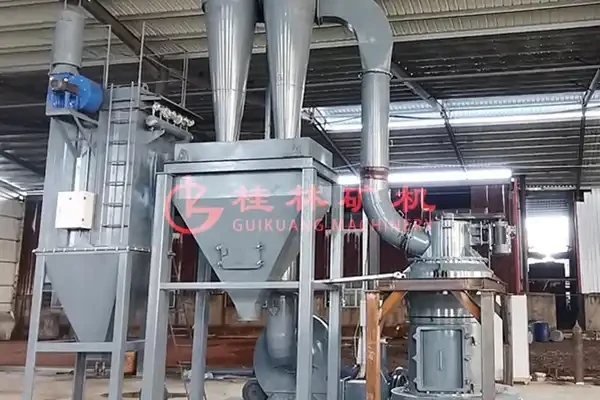
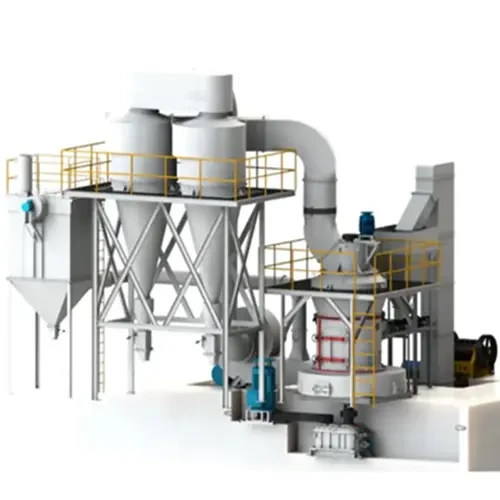
The pendulum Raymond grinding mill adopts the classic pendulum structure first launched in 1906. After centuries of technical upgrading, it features mature technology and stable operation. It is the most widely used general-purpose equipment with the largest installed capacity in the global non-metallic mineral processing industry. It has long maintained a market share of over 60% for powder production ranging from 80 mesh to 400 mesh.
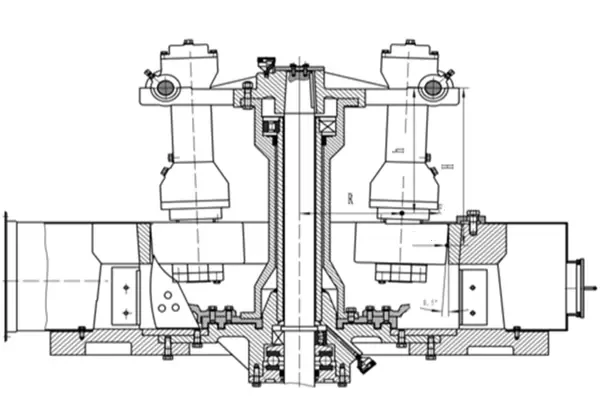
Grinding Roller Assembly: Horizontally suspended on the star frame via a cross shaft. Both ends of the shaft are connected to the star frame with rubber sleeves. The rubber sleeves serve for shock absorption and small radial swing.
Roller Sleeve Structure: Single-cylinder integrated design. The grinding roller shaft and roller body are installed inside the cylinder with two sets of upper and lower tapered roller bearings. It has fewer components, low processing and assembly difficulty, and highly versatile spare parts.
Swing Characteristics: The grinding roller tilts and swings outward around the horizontal cross shaft. During operation, the axis of the grinding roller keeps a fixed angle with the main shaft. It has a negative swing angle of about 0.5°, with the roller center offset roughly 5 mm from the grinding ring center.
Bearing Load: Bearings bear both radial and axial loads with uneven load distribution. The lower bearing undertakes approximately 70% of the total grinding force, which easily causes accelerated local wear after long-term running.
Working Principle: The main motor drives the star frame to rotate. The suspended grinding roller assemblies revolve with the star frame while spinning. Under centrifugal force, the grinding roller tilts outward and presses tightly against the grinding ring. The grinding force concentrates on a narrow contact line and gradually decreases from the lower end to the upper end of the roller, resulting in uneven grinding force distribution. The centrifugal force cannot be fully converted into grinding force, leading to energy loss (Grinding force = Centrifugal force × h/H, h/H ≈ 0.8).
Introduction to Longitudinal Swing Raymond Grinding Mill
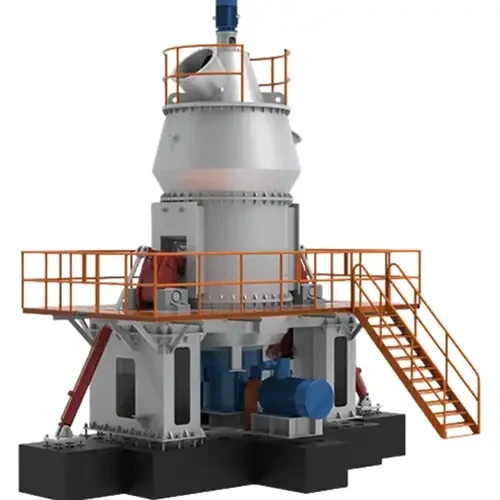
The longitudinal swing Raymond grinding mill appeared in the early 21st century. It was optimized to solve the limitations of the negative swing angle of pendulum models. The grinding roller and ring wear more evenly, and the service life is 1~1.5 times longer than that of pendulum structures. Nevertheless, its swing joint and sealing system bear complex loads, prone to wear and aging. Its later maintenance cost is far higher than the pendulum type. So far, there is no perfect solution combining low cost and high reliability.
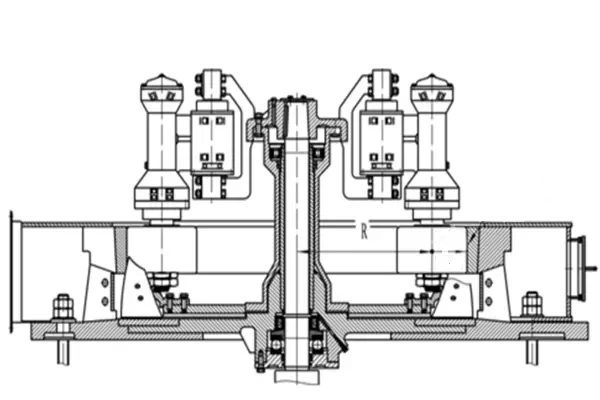
Grinding Roller Assembly: Vertically mounted on the star frame through a longitudinal shaft. The upper and lower ends of the longitudinal shaft are rigidly fixed to the star frame. It delivers better structural stability than the flexible suspension of pendulum type, yet with more linked parts.
Roller Sleeve Structure: Double-cylinder parallel design. The right cylinder holds the roller shaft and grinding roller, while the left cylinder is sleeved loosely on the longitudinal shaft to form an independent swing joint. It requires higher processing precision and assembly accuracy than the single-cylinder pendulum structure.
Swing Characteristics: The grinding roller swings outward in parallel around the vertical longitudinal shaft. Its axis remains strictly parallel to the main shaft during operation without negative swing angle, enabling full contact between roller and grinding ring.
Bearing Load: Bearings almost take pure radial loads, evenly distributed on all raceway surfaces with no extra axial component. Theoretically, bearing wear is more uniform. However, affected by the swing structure, the sealing system suffers more complex stress.
Working Principle: Driven by centrifugal force, the grinding roller swings outward parallel to the main shaft. The entire cylindrical surface of the roller makes full-area parallel contact with the grinding ring. Grinding force is evenly distributed over the contact surface. The pressure per unit area is 25%~30% higher than the pendulum type. Centrifugal force can be fully converted into grinding force (Grinding force = Centrifugal force) for better grinding efficiency. Still, continuous small-amplitude high-frequency swing (0~10°) will keep stressing the swing joint and sealing assembly, causing wear and aging.
Structural Comparison between Pendulum and Longitudinal Swing Raymond Grinding Mill
| Pendulum Raymond Grinding Mill | Longitudinal Swing Raymond Grinding Mill |
| Single-cylinder integrated, simple structure, low precision requirement | Double-cylinder parallel, complex process, high precision requirement for machining & assembly |
| Inclined line contact, with negative swing angle | Parallel surface contact, no negative swing angle |
| Grinding force reduced by about 20%, slightly higher power consumption | No grinding force loss, unit power consumption 15%~25% lower |
| Uneven wear of roller and ring, higher replacement frequency | Even wear of roller and ring, service life extended by 1~1.5 times |
| Low initial investment, spare parts easy to source and universal | High procurement cost, expensive seals and swing joint parts |
| No high-frequency swing joint, reliable sealing, 24h continuous operation | Weak dynamic seal, swing joints prone to looseness, stability drops rapidly over time |
| Bearing service life: 8000~10000h | Bearing service life: 5000~7000h |
| Simple operation, short maintenance downtime | Difficult maintenance, long downtime |
Why Longitudinal Swing Raymond Grinding Mill Has Not Become the Mainstream in the Market?
Although longitudinal swing Raymond mills achieve theoretical improvements in grinding efficiency and output compared with pendulum ones, their complex swing structure brings intractable high-frequency dynamic sealing problems, resulting in high later maintenance costs and far lower production stability than pendulum models.
Its core defect comes from the fundamental conflict between structure and working conditions: the precision swing joint designed for high-efficiency grinding inevitably faces rapid sealing failure in heavy dust environments. Once rubber seals age, fine dust invades the bearing cavity and causes frequent bearing damage. The high disassembly and repair cost far exceeds the electricity saved by the theoretical efficiency gain.
Besides, the intricate star frame and joint structure require highly skilled maintenance personnel, which ordinary repairmen cannot handle. Many users recognize its high output after purchase, yet get frustrated after several bearing failures due to unaffordable repair costs. These units then flow into the second-hand market with very low resale value. Buyers usually know at first glance: seals are easy to break and bearings tend to seize up.
While the pendulum structure suffers grinding force loss caused by negative swing angle, it features an extremely simple design without high-frequency swing joints, reliable sealing and easy maintenance, delivering the lowest full-life-cycle cost. For conventional powder production of 80~400 mesh, pendulum mills can steadily satisfy most users’ production needs with mature technology, low failure rate and readily available universal spare parts. It fits SMEs and multi-material processing scenarios perfectly.
For large-scale production pursuing long-term stability and low maintenance cost, vertical grinding mills are more preferred in the industry. Though vertical mills cost more initially than longitudinal swing Raymond mills, they have low operational and maintenance costs for continuous mass production, higher return on investment and better powder uniformity.

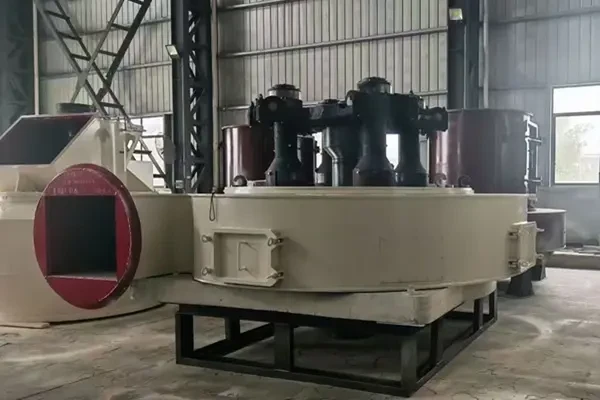
With over half a century of technical accumulation, Guilin Mining Machinery sticks to the core design philosophy of “Practical, Reliable & Economical”. Instead of blindly chasing theoretical parameter upgrades, we adopt mature solutions verified by the market. This is one major reason why GK Raymond Grinding Mills keep using pendulum roller assemblies. This design wins consistent praise from customers, and these machines almost never enter the second-hand market.
- Previous Article:Not Available
- Next Article:Limestone Grinding Mill Selection Guide
 Home
 Products
 About
 Call