

How to Select the Elevator for Raymond Mill?
- Time:2026-11-11
- Views:0
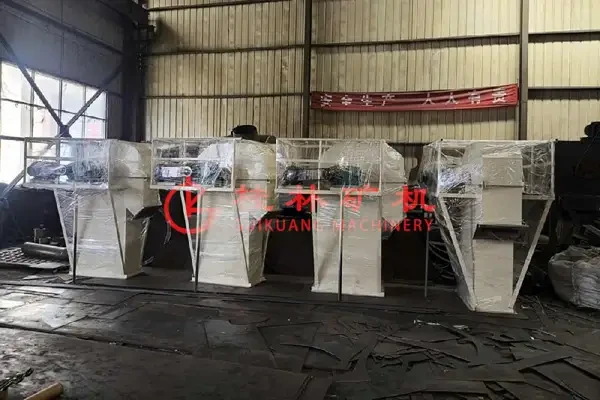
Bucket elevators provide vertical conveying for Raymond mills. Belt type bucket elevators are popular and low-cost for powder, fine particles and soft materials. Round chain bucket elevators are wear and heat resistant for lumpy, medium-hard and hard materials. Plate chain bucket elevators are heavy-duty models with high throughput for big, hard lumps.
Function of Elevator in Raymond Mill System
In the grinding production line, the elevator is the key equipment to vertically convey the crushed raw materials to the silo of the Raymond mill. It stably and continuously feeds materials with qualified particle size into the grinding mill. Improper selection of the elevator will lead to insufficient conveying capacity, material blockage, even frequent equipment failures and affect the stable operation of the whole production line. Therefore, scientific selection of elevator according to material characteristics, conveying height and output requirements is an important link to ensure the efficient and stable operation of the Raymond mill.
Common Types of Matching Elevators for Raymond Mill
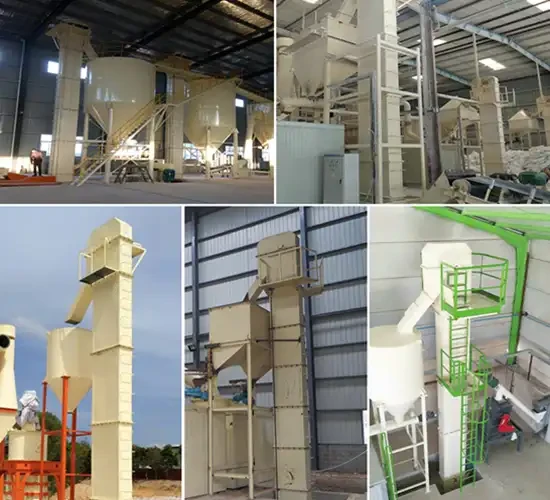
The commonly used elevator types in Raymond mill system include belt bucket elevator (TD type), round chain bucket elevator (TH/HL type) and plate chain bucket elevator (NE type). Among them, TH type is an upgraded product of HL type, with better advantages in conveying capacity and operation reliability.
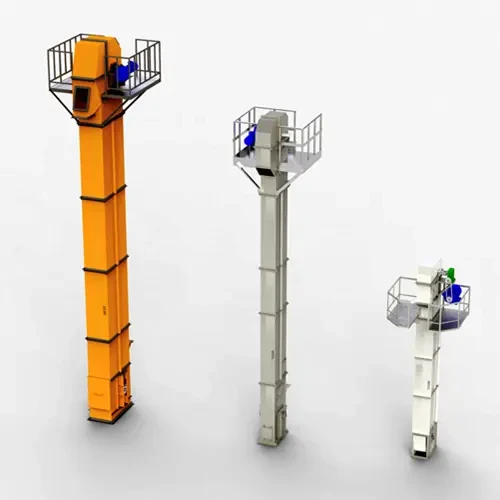
From left to right: plate chain bucket elevator, round chain bucket elevator, belt bucket elevator
| Comparative Analysis of Common Matching Elevators for Raymond Mill | ||
| Belt Bucket Elevator | Round Chain Bucket Elevator | Plate Chain Bucket Elevator |
Traction part: rubber belt | Traction part: round link chain | Traction part: plate chain (sleeve roller chain) |
| Lifting height ≤40m | Lifting height ≤50m | Lifting height ≤60m |
| Material temperature ≤80℃ (heat-resistant belt ≤200℃) | Material temperature ≤250℃ | Material temperature ≤250℃ |
| Suitable for powdery, small-particle and low-hardness materials | Suitable for lumpy, medium and high-hardness materials | Suitable for lumpy and high-hardness materials |
| Simple structure, low cost and stable operation | Wear-resistant and high-temperature resistant | Heavy-duty design, large conveying capacity (≤800m³/h) |
Selection Suggestions for Matching Elevators of Raymond Mill
Material Temperature
Normal-temperature materials: For conventional powder ≤80℃ such as calcite, talc and barite, belt bucket elevator is the first choice with the best cost performance and stable running.
Medium-temperature materials: For dried materials of 80℃~200℃, belt bucket elevator with heat-resistant belt or round chain bucket elevator is optional.
High-temperature materials: For hot materials of 200℃~250℃, round chain bucket elevator or plate chain bucket elevator is available. Belt bucket elevator cannot be adopted, because the rubber belt will rapidly age and fail under such temperature.
Material Properties
Powdery, small-particle and low-hardness materials: Such as cement, coal powder and gypsum powder, belt bucket elevator is selected with the lowest cost.
Lumpy, medium and high-hardness materials: Such as limestone, clinker and coal lumps, round chain bucket elevator or plate chain bucket elevator can be chosen. Round chain type has lower price, while plate chain type features better wear resistance and longer service life. The belt will be cut or worn through under this working condition.
Large lumpy and high-hardness materials: Such as iron ore and granite crushed stone, plate chain bucket elevator must be selected. Its chain has strong wear resistance and long service life.
Mill Capacity
Small production line: For Raymond mills with output ≤10t/h, you can choose belt bucket elevator (lower cost) or plate chain bucket elevator (slightly higher cost) according to your budget.
Medium production line: For Raymond mills with output of 10~30t/h, select belt bucket elevator for powdery materials or plate chain bucket elevator for lumpy materials according to material characteristics.
Large production line: For Raymond mills with output >30t/h, plate chain bucket elevator is preferred. It has large conveying capacity and low failure rate, bringing lower comprehensive cost for long-term operation.
Lifting Height
Height ≤40m: All three types are available, and belt bucket elevator has the best economy.
Height 40~50m: Choose round chain bucket elevator or plate chain bucket elevator. Belt bucket elevator has large elongation and reduced stability at this height.
Height ≥50m: Plate chain bucket elevator must be adopted. Its plate chain structure has the strongest bearing capacity and is suitable for high-lift conveying.
Pitfall Avoidance Guide for Matching Elevators of Raymond Mill
Mismatch Between Elevator Conveying Capacity and Raymond Mill
If the conveying capacity of the bucket elevator is far greater or less than the processing capacity of the Raymond mill, material accumulation and mill idling without feeding will occur when the capacity is insufficient; when the capacity is excessive, the equipment will be idle, investment wasted and start-stop frequently.
The correct practice is that the conveying capacity of the elevator should be slightly 1.1~1.2 times the processing capacity of the Raymond mill. Meanwhile, a transfer silo shall be set between the elevator discharge port and the grinding mill, with the capacity meeting the mill consumption for 2~4 hours for buffering and adjustment.
Wrong Selection of Ordinary Belt Elevator for High-temperature Materials
Directly feeding hot materials over 80℃ (such as dried limestone) into ordinary belt bucket elevator will cause rapid aging, cracking or even breakage of the rubber belt, resulting in equipment shutdown and high maintenance & replacement cost.
The correct solution is to replace ordinary rubber belt with heat-resistant belt, or switch to other heat-resistant elevators such as plate chain elevator.
Wrong Selection of Belt Elevator for High-hardness Materials
Using belt bucket elevator to convey hard lumpy materials such as iron ore will lead to belt cutting, rapid wear, loose and falling bucket bolts and frequent equipment failures.
The correct practice is to switch to round chain bucket elevator or plate chain bucket elevator. Both chains have better wear resistance than rubber belt.
- Previous Article:Not Available
- Next Article:How to Choose the Matching Feeder for Raymond Mill?
 Home
 Products
 About
 Call