

How to Choose the Matching Feeder for Raymond Mill?
- Time:2026-11-09
- Views:1
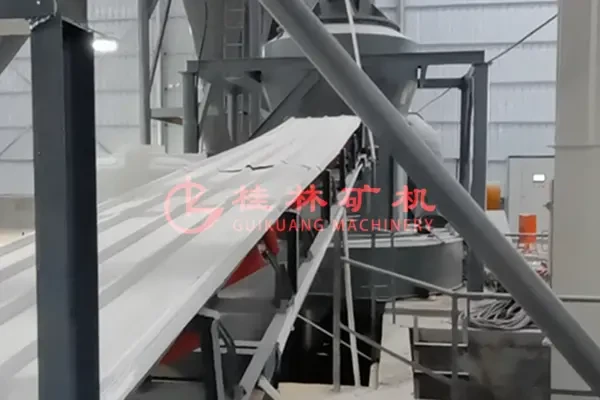
The feeder delivers materials uniformly, continuously and quantitatively to the Raymond mill. Among them, the vibrating feeder is suitable for conveying granular and lump materials, the belt feeder for granular, powdery and lump materials, and the screw feeder for powdery and small granular materials. Screw feeders must not be used for lump materials and high-moisture materials.
Function of Feeder in Raymond Mill System
In a powder grinding production line, the feeder serves as critical equipment connecting the crusher and Raymond mill. It feeds crushed materials into the Raymond mill mainframe in a uniform, continuous and controllable manner. The stability of the feeding system determines the production efficiency of the Raymond mill. Insufficient feeding will cause direct contact between grinding rollers and grinding rings, accelerating wear and even triggering equipment failures. Excessive feeding will lead to soaring main motor current, air duct blockage and fluctuating finished powder fineness. Therefore, selecting a proper matched feeder is essential to guarantee efficient and stable operation of the Raymond mill.
Common Types of Feeders Matched with Raymond Mill
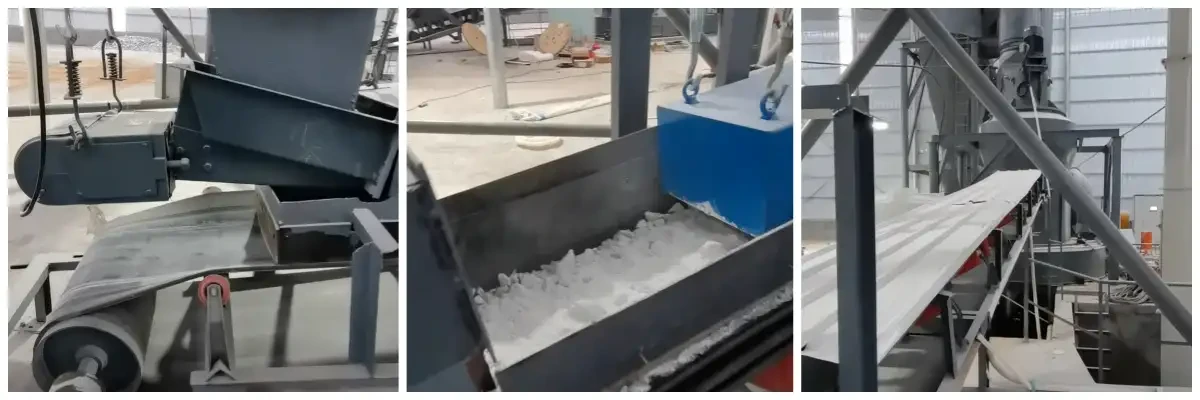
Vibrating feeders, belt feeders and screw feeders are widely adopted in Raymond mill systems.
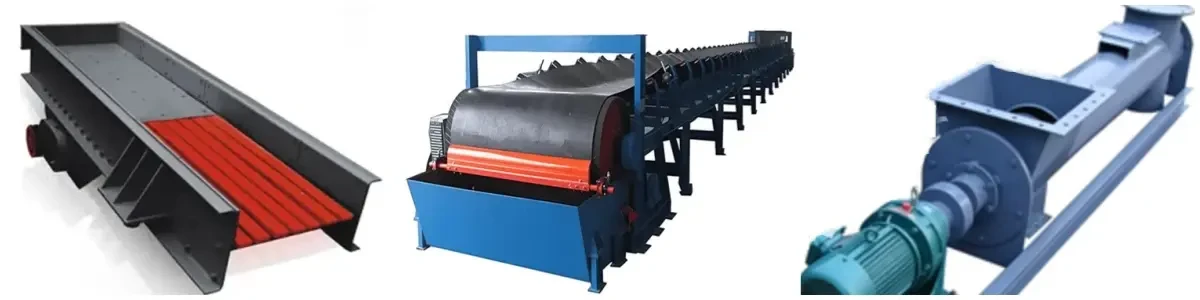
Vibrating Feeder (Left), Belt Feeder (Middle), Screw Feeder (Right)
| Comparative Analysis of Common Feeders for Raymond Mill | ||
| Vibrating Feeder | Belt Feeder | Screw Feeder |
| High-frequency vibration generated by excitation source (electromagnet or motor) for uniform and continuous material conveying | Motor drives belt pulley for cyclic operation to realize continuous material feeding | Motor drives screw blades to rotate and push materials continuously |
| Uniform feeding, sensitive adjustment, simple structure and low power consumption | Long-distance conveying, stable feeding, strong impact resistance | Compact structure, good sealing performance, vertical conveying available |
| Not suitable for sticky and wet materials (easy blockage) | Large footprint, belt prone to wear | Not suitable for lump materials and high-moisture materials |
| Suitable for granular and lump materials (5~100mm) | Suitable for granular, powdery and lump materials (0~100mm) | Suitable for powdery and small granular materials (<10mm) |
Selection Suggestions for Feeders Matched with Raymond Mill
Material Moisture Content
Dry materials (moisture <5%): Choose vibrating feeder. It has no rotating parts and no material retention zone, featuring high feeding accuracy and easy automatic control.
Sticky and wet materials (moisture 5%~10%): Belt feeder is preferred. Materials hardly stick to the belt surface, so it tolerates higher moisture. For special working conditions, vibrating feeder can be adopted with increased trough inclination (usually 10°~15°).
High-moisture materials (moisture >10%): Select belt feeder. Screw feeder is strictly forbidden for high-moisture materials, as blockages tend to form between screw blades and trough.
Material Particle Size
Lump materials (>50mm): Motor-type vibrating feeder or belt feeder is recommended. Both have strong conveying capacity and can withstand impact from lump materials.
Granular materials (<10mm): Vibrating feeder is preferred for uniform feeding and precise control. Screw feeder is optional for vertical conveying conditions.
Powdery materials: Adopt screw feeder with good sealing effect to effectively prevent dust leakage.
Feeding Accuracy
Continuous feeding: Raymond mill requires uniform and continuous feeding. Electromagnetic vibrating feeder with frequency conversion control is commonly used to adjust feeding volume automatically and avoid mill overload or idling.
Quantitative feeding: For scenarios with metering requirements, belt feeder matched with frequency converter and belt scale is widely used. It delivers high control accuracy and integrates continuous metering and feeding.
Precision feeding: For chemical raw material grinding with strict raw material proportion control, screw feeder together with belt scale is required. The screw feeder realizes sealed conveying and precise metering of powder, and the feeding accuracy can be controlled within ±0.5%.
High-volume feeding: For large Raymond mill production lines with single-unit capacity above 10 t/h, an intermediate silo is usually arranged between crusher and Raymond mill. Vibrating feeder or belt feeder is installed under the silo, selected according to material properties and site layout.
Pitfall Avoidance Guide for Raymond Mill Supporting Feeders
Using Vibrating Feeder Directly for High-moisture Materials
Feeding clayey limestone, kaolin and other materials with moisture content over 8% directly into vibrating feeder will cause material adhesion and agglomeration on the trough, resulting in discontinuous feeding or feeding interruption. The Raymond mill will idle frequently and output drops.
The correct solution is to use belt feeder, or install drying equipment to dry materials before feeding and ensure the moisture content of incoming materials below 6%.
Using Screw Feeder for Lump Materials
Feeding materials larger than 20 mm into screw feeder will lead to material jamming between screw blades and trough, causing motor overload, blade deformation or fracture, and even motor burnout in severe cases.
The correct solution is to switch to vibrating feeder or belt feeder.
Mismatched Capacity between Feeder and Raymond Mill
If the maximum feeding capacity of the feeder is far higher or lower than the design capacity of the Raymond mill, feeding will be uneven and the mill cannot run efficiently. Excessive feeding capacity easily triggers mainframe overload, while insufficient feeding capacity leads to frequent mill idling.
The correct solution is reasonable capacity matching. The handling capacity of the feeder should be 1.1~1.2 times the capacity of the Raymond mill.
Ignoring Sealing at Feeding Port during Feeder Installation
Without soft connection sealing between feeder and Raymond mill inlet, or with aging and damaged sealing parts, air leakage at the feeding port will reduce finished powder collection efficiency and cause dust overflow.
The correct solution is to install flexible sealing devices (canvas soft connector, silicone soft joint, etc.) between feeder outlet and Raymond mill inlet, and check the sealing integrity regularly.
- Previous Article:Not Available
- Next Article:How to Select the Supporting Crusher for Raymond Mill?
 Home
 Products
 About
 Call