

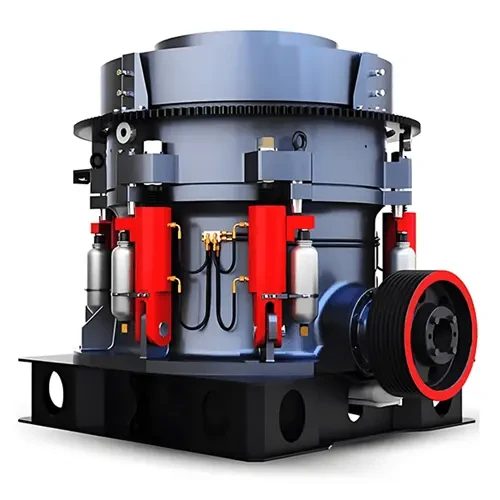
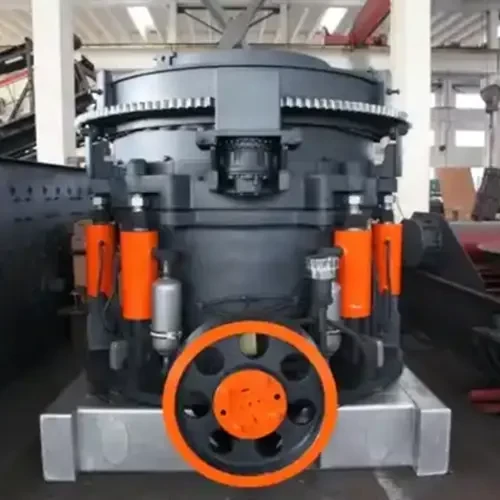
Cone Crusher
Production Output:12~1200 t/h
Feed Size:≤560 mm
Product Size:≤76 mm
Suitable Materials:Iron ore, copper ore, zinc ore, gold ore, manganese ore, limestone, dolomite, barite, marble, granite, silicon carbide, gypsum, etc.
Cone Crusher Introduction
A cone crusher works on the principle of laminated crushing. It repeatedly squeezes materials to achieve size reduction and excels in processing high-hardness materials. Hydraulic cone crushers dominate the current market. Equipped with a full hydraulic system to replace mechanical springs, they deliver more precise discharge gap control and tramp iron protection, gradually phasing out traditional spring cone crushers and composite cone crushers (second-generation transitional products). In Raymond mill grinding processes, single-cylinder hydraulic cone crushers are commonly deployed for secondary or tertiary crushing stages. For materials with high hardness or stricter requirements on particle shape and fineness, multi-cylinder hydraulic cone crushers are the preferred option.
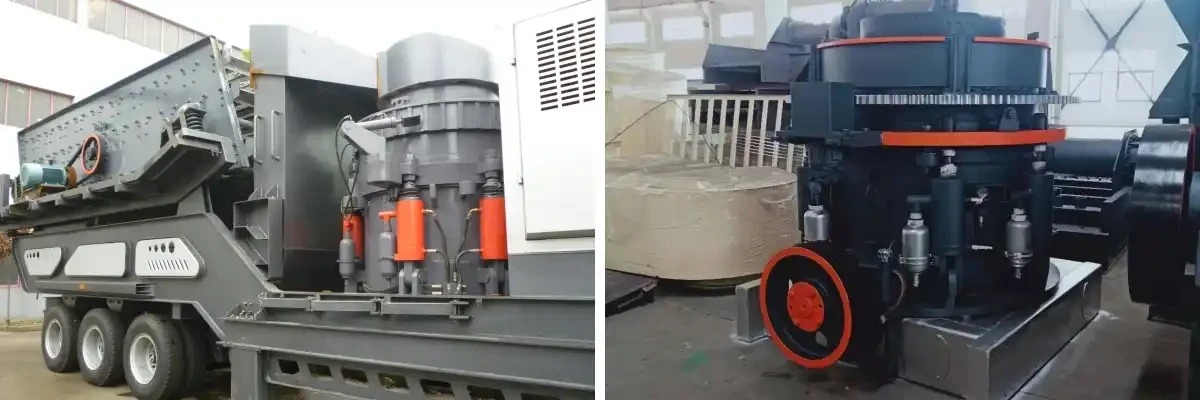
Cone Crusher Features & Advantages
Single-Cylinder Hydraulic Cone Crusher
Simple & Convenient: Compact and simple structure with one hydraulic cylinder at the machine base, fewer spare parts for easy operation and maintenance. The main shaft adopts simply supported beam support for favorable stress conditions and high reliability.
High Crushing Efficiency: Optimized combination of stroke, speed and crushing chamber profile compared with traditional spring cone crushers. With the same moving cone diameter, output can rise by 35%~60%.
Automatic Cavity Clearing: When uncrushable metal blocks or foreign objects enter the crushing chamber, the hydraulic system automatically widens the discharge opening to eject them and resets automatically afterwards. In case of blockage, the hydraulic system lifts and lowers the moving cone repeatedly to clear accumulated materials easily without manual intervention.
Wide Adaptability: By replacing the concave liner, it can switch between different chamber profiles for secondary crushing, fine crushing and other process requirements.
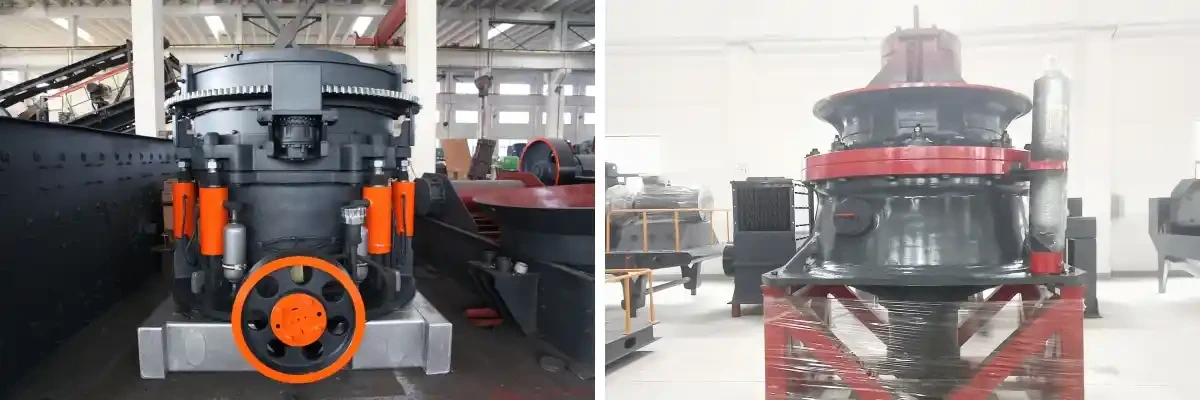
Multi-Cylinder Hydraulic Cone Crusher
Superior Particle Shape: Multi-cylinder surrounding structure enables uniform and stable laminated crushing. Finished aggregates tend to be cubic with low flaky and elongated particle content.
Heavy-Duty Crushing: Applies stronger compression and shear force to materials. Under the same specification, processing capacity increases by over 30% versus single-cylinder models, ideal for high-hardness materials.
Multi-Protection Design: Multiple hydraulic cylinders mounted around the machine act both as locking devices and tramp iron protection units. When uncrushable material enters, the hydraulic system retracts the moving cone rapidly, then resets automatically after discharge without shutdown for outstanding equipment stability.
Multi-Purpose Machine: Changing liners allows switching between standard and short-head chamber profiles to suit secondary and fine crushing needs, delivering high equipment utilization.
| Cone Crusher Comparison | ||
| Single-Cylinder Hydraulic Cone Crusher | Multi-Cylinder Hydraulic Cone Crusher | Spring Cone Crusher |
| Main shaft lifted/lowered via bottom single cylinder for stepless discharge gap adjustment | Independent hydraulic motor rotates adjustment ring without disturbing crushing force field | Manual mechanical spring adjustment, stepped adjustment |
| Hydraulic system automatic pressure relief widens discharge opening; resets after foreign object discharge | Synchronized pressure relief of multi-cylinders retracts moving cone; resets after foreign object discharge | Spring compression enlarges discharge opening; spring resets after foreign object discharge |
| Hydraulic system rapid cylinder lowering for cavity clearing | Hydraulic system assisted cavity clearing | Manual cleaning required, long downtime |
| Good finished particle shape | Excellent finished particle shape, low flaky content | Average finished particle shape |
| Simple structure, fewer parts, low maintenance cost | Complex surrounding multi-cylinder structure, higher maintenance cost | Simple structure but cumbersome adjustment |
| Medium investment cost | High investment cost | Low investment cost |
| Moderate crushing force, suitable for secondary & fine crushing | Heavy-duty crushing, good for high-hardness materials | Limited spring pressure with low crushing force, gradually replaced by hydraulic models |
Cone Crusher Working Principle
It relies on laminated crushing between moving cone and fixed cone to squeeze and impact materials repeatedly for efficient size reduction. The single-cylinder hydraulic system lifts and lowers the moving cone main shaft via one bottom hydraulic cylinder to realize stepless discharge gap adjustment. During tramp iron incidents, the hydraulic system automatically relieves pressure to widen discharge opening for foreign object ejection and auto-reset. Material blockages can be cleared quickly by lowering the moving cone.
For multi-cylinder hydraulic versions, the moving cone is top-suspended, with multiple surrounding hydraulic cylinders delivering uniform crushing force. Discharge gap is adjusted by an independent hydraulic motor rotating the adjustment ring without affecting the crushing force field. Multiple cylinders release pressure synchronously for tramp iron protection when uncrushable material enters.
Cone Crusher Application Scenarios
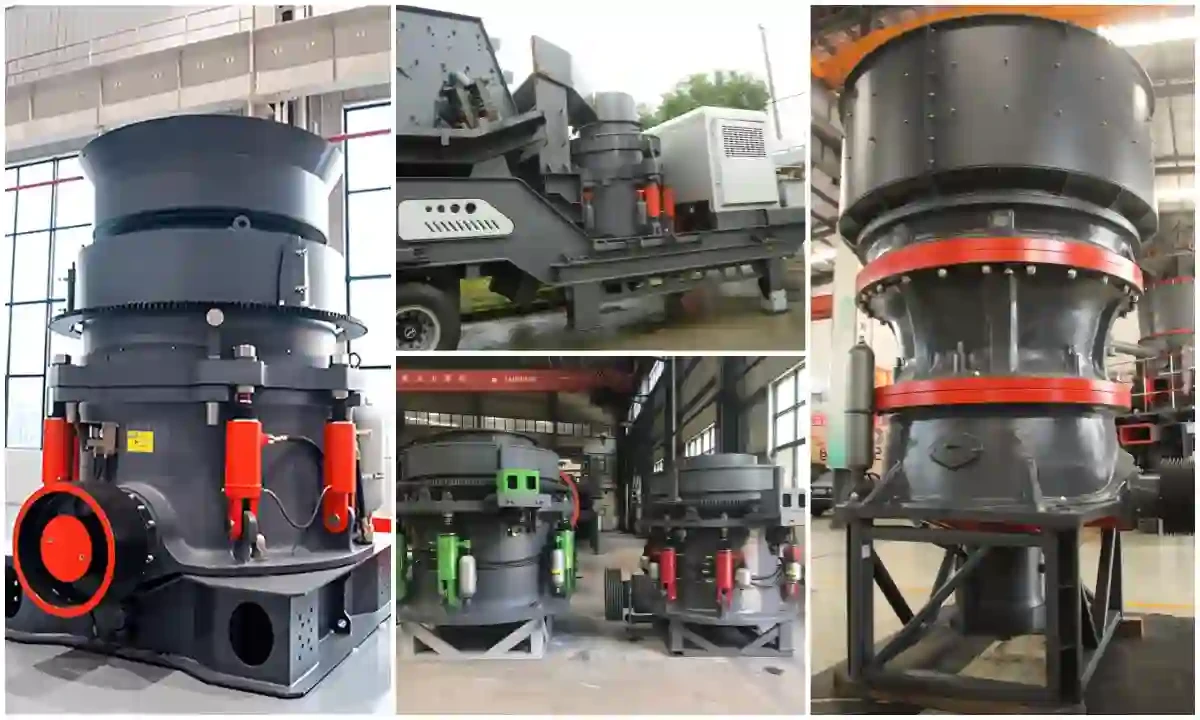
Cone Crusher Technical Parameters
| Single-Cylinder Hydraulic Cone Crusher Parameter Table | |||||
| Model | Chamber Profile | Feed Size (mm) | Discharge Size (mm) | Capacity (t/h) | Power (kW) |
| HS200 | C | ≤200 | 16~32 | 77~123 | 90 |
| EC | ≤240 | 22~38 | 102~162 | ||
| HS300 | C | ≤300 | 25~48 | 170~237 | 132 |
| EC | ≤360 | 25~54 | 151~304 | ||
| HS400 | C | ≤400 | 32~51 | 291~503 | 220 |
| EC | ≤450 | 35~54 | 273~495 | ||
| HS500 | C | ≤500 | 35~70 | 335~755 | 315 |
| EC | ≤560 | 38~76 | 331~792 | ||
| * Data for reference only, actual parameters vary with raw materials | |||||
| Multi-Cylinder Hydraulic Cone Crusher Parameter Table | |||||
| Model | Chamber Profile | Feed Size (mm) | Discharge Size (mm) | Capacity (t/h) | Power (kW) |
| HP200 | C | ≤150 | 16~38 | 120~240 | 160 |
| F | ≤76 | 6~16 | 55~180 | ||
| HP300 | C | ≤225 | 16~38 | 150~430 | 220 |
| F | ≤86 | 6~16 | 90~260 | ||
| HP400 | C | ≤290 | 16~38 | 190~610 | 315 |
| F | ≤100 | 6~16 | 108~320 | ||
| HP500 | C | ≤320 | 19~44 | 230~700 | 400 |
| F | ≤110 | 8~19 | 145~430 | ||
| * Data for reference only, actual parameters vary with raw materials | |||||
Frequently Asked Questions About Cone Crusher
How to choose between single-cylinder and multi-cylinder hydraulic systems for cone crushers?
Single-cylinder hydraulic system: Suitable for projects with limited budget, processing medium-hardness materials such as limestone, prioritizing high throughput and easy maintenance.
Multi-cylinder hydraulic system: Ideal for high-hardness materials like granite and basalt, cases requiring excellent finished particle shape, high output and low failure rate.
Why do hydraulic cone crushers replace composite cone crushers?
Composite cone crushers adopted hydraulic cavity clearing, yet discharge gap adjustment remained manual while crushing force was still spring-supplied. Hydraulic cone crushers adopt full hydraulic drive, delivering easier cavity clearing, higher automation, more stable running and superior aggregate particle shape.
Can cone crushers process high-moisture materials?
Processing high-moisture materials is generally not recommended. Cone crushers are sensitive to sticky wet materials and prone to blockages, so they should avoid materials with high moisture or high mud content.
 Home
 Products
 About
 Call