

How to Select the Supporting Crusher for Raymond Mill?
- Time:2026-11-06
- Views:0
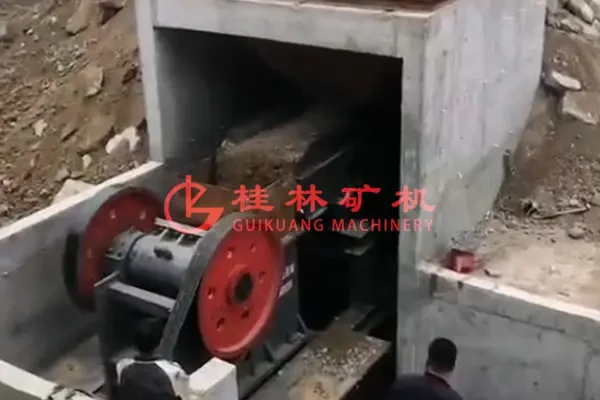
The crusher is the pre-processing equipment for Raymond mills. Jaw crushers are mainly used for primary crushing, impact crushers, hammer crushers and cone crushers are commonly used for secondary crushing, and cone crushers and sand making machines are the primary choices for fine crushing.
Function of Crushers in Raymond Mill System
In a powder grinding production line, the crusher serves as the pre-processing equipment for the Raymond mill. It crushes bulk raw materials down to the feed size standard of the Raymond mill (≤30mm), which the grinder can handle. This reduces the load of the subsequent grinding process and improves production efficiency. Evenly crushed raw materials also help upgrade finished powder quality. Improper crusher selection will lead to oversized feed particles, accelerating wear of grinding parts such as grinding rollers and rings. Unsuitable crushing size directly cuts the grinding efficiency of the Raymond mill and causes fluctuations in finished product quality. Therefore, scientifically selecting crushers according to material characteristics is the primary step for stable and efficient operation of Raymond mills.
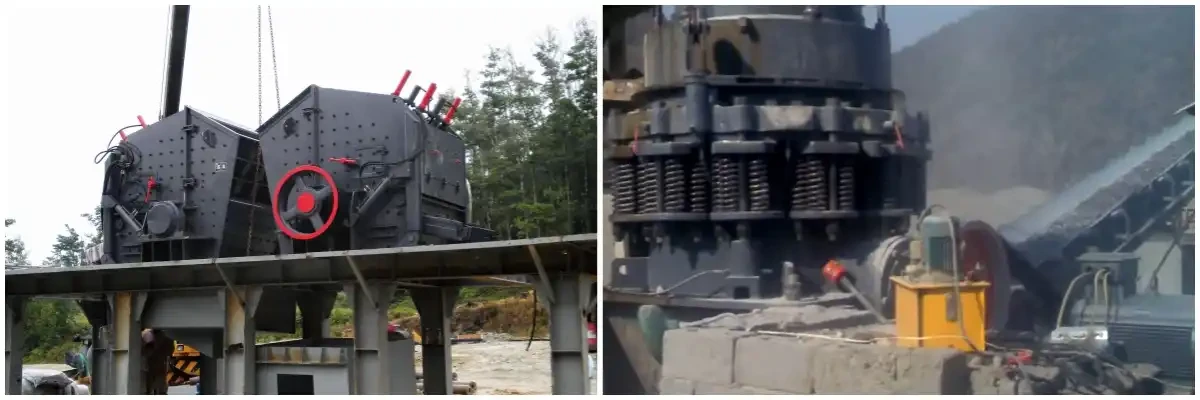
In the pre-crushing stage, crushing procedures are divided into primary crushing, secondary crushing and fine crushing to process materials of different hardness and meet the feed size requirement of Raymond mills.
| Function of Crushers in Raymond Mill System | ||
| Primary Crushing | Secondary Crushing | Fine Crushing |
| Jaw crushers are mainly used for crushing large run-of-mine ore | Impact crushers, hammer crushers and cone crushers can further crush materials after primary crushing | Cone crushers and sand making machines are mainly adopted for further fine crushing and shaping of secondary crushed materials |
Common Types of Supporting Crushers for Raymond Mills
Common crusher types matched with Raymond mill systems include jaw crusher, impact crusher, hammer crusher and cone crusher.
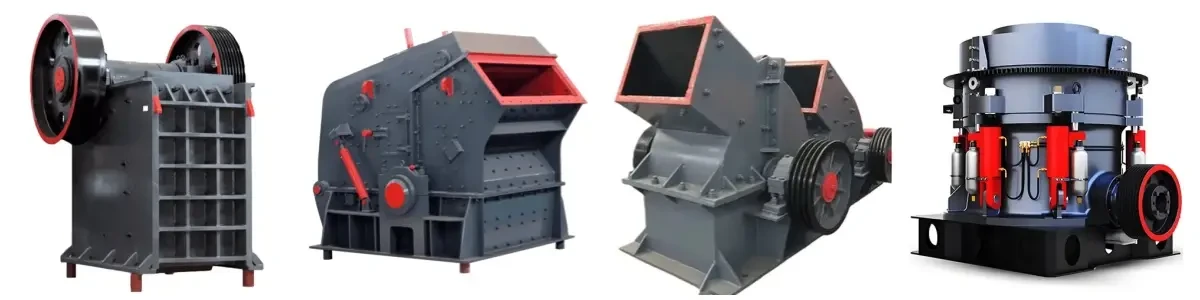
From left to right: jaw crusher, impact crusher, hammer crusher, cone crusher
| Comparative Analysis of Common Supporting Crushers for Raymond Mills | |||
| Jaw Crusher | Impact Crusher | Hammer Crusher | Cone Crusher |
| Compression crushing, moving jaw squeezes fixed jaw | Impact crushing, blow bar strikes impact plate | Impact & shear crushing, hammer hits sieve plate | Compression & grinding crushing, moving cone squeezes fixed cone |
| Mainly for primary crushing | Mainly for secondary crushing | Mainly for secondary & fine crushing | Mainly for secondary & fine crushing |
| Handles materials of all hardness levels | For medium & low hardness materials | For medium & low hardness materials | Ideal for high hardness materials |
| Good wear resistance, relatively low cost | Large crushing ratio, excellent particle shape | Ultra-large crushing ratio, low investment cost | Strong wear resistance, good particle shape |
Selection Suggestions for Raymond Mill Supporting Crushers
Raw Material Hardness
High-hardness materials: Such as granite, basalt, iron ore, river pebble and others with Mohs hardness>7. Jaw crushers are adopted for primary crushing to break large blocks with high squeezing force. Cone crushers are recommended for secondary and fine crushing. Currently, cone crushers are the most cost-effective solution for secondary & fine crushing of high-hardness materials. They adopt laminated crushing principle to break hard rock by compression and grinding. Their wear parts (bowl liner, mantle) enjoy much longer service life than hammers and blow bars. Despite higher initial investment, they feature obvious advantages in comprehensive operating cost and stability over long-term running.
Medium & low-hardness materials: Such as limestone, calcite, dolomite with Mohs hardness ≤7. Jaw crushers are generally used for pre-processing in primary crushing, while hammer crushers or impact crushers dominate secondary crushing. Heavy hammer crushers can even finish secondary and fine crushing in one pass to simplify the workflow. Note that hammer crushers fit these soft rocks but are not suitable for materials with excessive moisture (water content above 8%~10%). Hammer crushers or fine jaw crushers (PEX type) can be used in fine crushing to guarantee feed size into the mill according to actual demands.
Material Moisture Content
Jaw crushers have the strongest adaptability and tolerate materials with high moisture and high mud content best. Hammer crushers are equipped with grates at the bottom; grate holes are prone to blockage under high humidity conditions, which also accelerates wear of hammers and grates. Impact crushers have no grate blockage risk but remain sensitive to muddy materials (mud easily sticks to crushing chamber). When moisture exceeds 10%~12%, crushing efficiency drops sharply. Cone crushers are highly sensitive to sticky wet materials and tend to get blocked, so they should be avoided for high-moisture or high-mud materials.
Process Mode
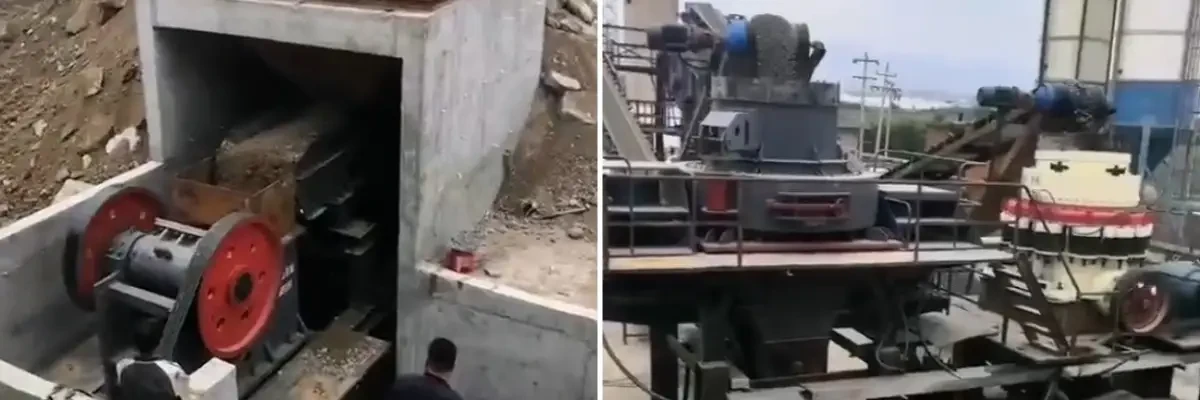
Non-metallic mineral processing: Single-stage crushing is mainstream. If raw ore size is not extremely large, one jaw crusher can crush materials down to the required feed size of Raymond mills (usually ≤30mm).
Metal ore processing: Follow the principle of more crushing and less grinding and adopt multi-stage crushing. Jaw crushers reduce ore to 200~300mm in primary crushing; cone or impact crushers crush to 50~100mm in secondary crushing; cone crushers deliver size ≤30mm in fine crushing. This minimizes feed particle size and keeps the Raymond mill running efficiently and stably.
Industrial solid waste processing: Crushers are usually unnecessary for slag and fly ash with uniform particle size. For block materials such as ceramic waste and steel slag, two-stage crushing (jaw crusher + impact crusher) is commonly used to reach the standard feed size for Raymond mills. (Note: Fine jaw crushers or hammer crushers can be considered for fine crushing if steel slag features high hardness or high iron content to cut wear cost.)
Chemical raw material processing: Special crushers lined with stainless steel or ceramic plates are required, matched with vibrating screens to form a closed-circuit crushing system. It prevents iron impurities from contaminating raw materials and ensures finished powder purity at the source.
Finished Particle Shape
If strict requirements are set for particle shape, choose impact crushers. Products from impact crushers are mostly cubic with very low flaky content (≤10%), suitable for limestone sand making, construction waste recycled aggregates and other medium & low-hardness materials. Sand making machines are the pick for top-tier particle shape, using rock-on-rock crushing principle for shaping. For hard rock processing (metal ore, granite etc.), wear reduction is the priority. Cone crushers (especially hydraulic type) are recommended. Though particle shape is slightly inferior (flaky content 12%~15%), the laminated crushing principle delivers longer service life for wear-resistant parts.
Pitfalls to Avoid When Matching Crushers for Raymond Mills
Trying to Crush Hard Rock with One Single Crusher
Attempting to crush large high-hardness materials such as granite and basalt in one pass by only one jaw crusher or hammer crusher leads to insufficient crushing force, rapid wear and equipment overload.
The correct solution is multi-stage crushing process, e.g. jaw crusher for primary crushing + impact crusher for secondary crushing + cone crusher for fine crushing.
Feeding Materials into Crushers Without Considering Moisture
Directly feeding clayey limestone with water content over 10% into impact, hammer or cone crushers will cause frequent shutdown for cavity cleaning and sharp output drop. Grate holes at the bottom of hammer crushers are easily clogged by wet materials. Sticky wet materials form buffer layers inside impact crushers and lower efficiency. Cone crushers are sensitive to wet feed, and extrusion may block discharge openings.
The right approach is pre-treatment by natural airing or drying equipment. Jaw crushers should be selected for wet crushing with properly enlarged discharge opening.
Crusher Capacity Far Larger Than Raymond Mill Capacity During Selection
Equipping a 50t/h crusher for a 10t/h Raymond mill will result in frequent start-stop and idling of the crusher, soaring unit power consumption and extra stacking space for crushed materials.
Match capacity reasonably. The crusher capacity should be 1.1~1.2 times that of the Raymond mill. A transfer silo (holding material for 2~4 hours of mill operation) shall be arranged between crushing and grinding sections.
Ignoring Iron Removal After Crushing
If iron separators are not installed after crushers, wear of crusher consumables such as jaw plates, hammers and liners will introduce iron impurities into raw materials. Direct feeding into the mill will harm finished powder quality and even damage grinding rollers and rings in severe cases.
Install iron separators after crushing and before feeding into the mill to form multi-stage iron removal protection.
- Previous Article:Not Available
- Next Article:How to Equip Magnetic Separator for Raymond Mill?
 Home
 Products
 About
 Call