

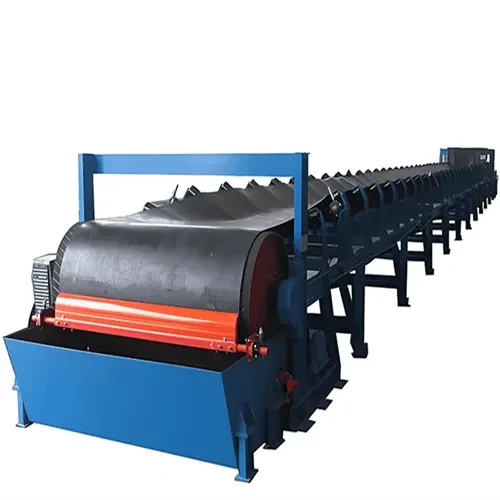
Belt Feeder
Belt Feeder Features & Advantages
Precise and Controllable: Variable frequency speed regulation or mechanical adjustment enables accurate control of feeding rate to guarantee uniform feeding to Raymond mills.
Strong Adaptability: Belt materials (heat-resistant, anti-stick, wear-resistant) can convey wet, sticky, high-temperature or moderately corrosive materials. Flat belts, side cleat belts, sealing covers and other components can be flexibly configured according to material characteristics.
Stable and Reliable: It adopts a simple mechanical structure with smooth power transmission and no impact vibration, featuring low failure rate during long-term operation.
Easy Integration: It can be flexibly integrated with weighing sensors, iron removers, dust hoods and other equipment, and can also be upgraded to a quantitative feeding system or enclosed dust-proof system.
Working Principle of Belt Feeder
Continuous Conveying: The motor drives the roller to rotate. Friction drives the endless belt to circulate, and materials move along with the belt to realize continuous conveying.
Flow Control: Variable frequency speed regulation and gate feeding control can adjust belt speed and material pile thickness, achieving stepless adjustment and precise control of feeding capacity.
Function Expansion: Install weighing frames and speed sensors on the frame to upgrade into high-precision quantitative feeders. Equipped with fully sealed housings, it can realize dust-free conveying.
 Home
 Products
 About
 Call